Nobody did that thing where they pretend not to notice. The bell over the diner door rang and every head snapped up like it was a gunshot. The kid who stepped in looked like the weather had tried to erase him—soaked hoodie clinging to his shoulders, hair plastered to his forehead, skinny hands bright red from the cold. He stood just long enough for the room to decide he was trouble, then bolted between tables like he already knew where safety lived.
He didn’t go for the counter, where the waitress could’ve offered a towel. He didn’t aim for the corner booths with families who looked like they had insurance. He ran straight to the man by the window—the one people pretended they didn’t see even though he was impossible to ignore. Big frame. Coat too heavy for the season. The kind of stillness that made everything around him feel louder. A puckered web of scars climbed up the left side of his face, disappearing into his hairline like a story that didn’t want to be finished.
The kid grabbed his sleeve with both hands and tucked himself behind the man’s leg as if he’d practiced it. The chair groaned when the man stood, slow and deliberate. You could feel the whole diner hold its breath. The cook paused mid-flip. A fork hovered over someone’s mouth. It wasn’t fear of the kid that pinned everyone in place. It was the fact the kid had chosen him.
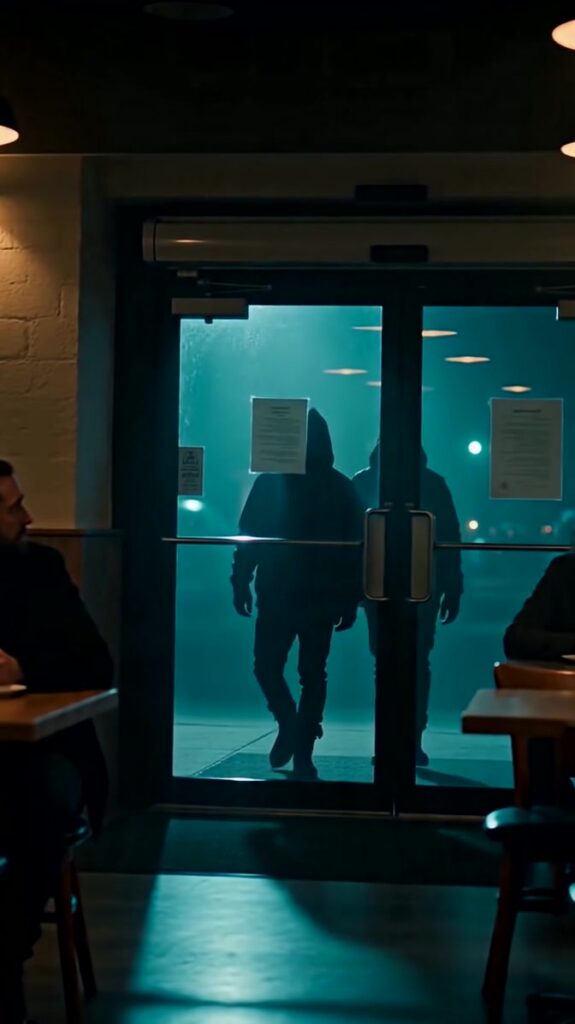
Outside, headlights washed across the wet parking lot. Two figures moved toward the glass, hoods up, shoulders squared. They weren’t rushing; they didn’t need to. The kind of people who walk like the world owes them room. The man by the window didn’t flinch. If anything, he looked annoyed—like someone had tracked mud into a house he’d just finished cleaning.
“Gideon,” the waitress at the counter breathed, not meaning to say it out loud. It slipped out anyway. Names do that when they carry weight. Gideon Cross had been a rumor the city liked to trade, the way you trade campfire stories even in daylight. People used to say he could stare down a charging pit bull. People used to say the docks belonged to him. Then there’d been a fire, the kind that makes the news and then gets buried in whispers. A woman dead. A baby missing. Gideon gone, like the city had swallowed him whole.
The kid’s shaking got worse, like his body was trying to vibrate right out of itself. He tugged Gideon’s sleeve and shoved something into Gideon’s hand. It was small and cold and shiny: a little fox-shaped zipper pull, worn smooth around the edges. Gideon stared at it too long for it to be normal. His fingers closed around it so tight his knuckles went pale.
He didn’t look down at the boy right away. He looked past him, through the glass, at the two men stepping inside. Cold air followed them in, sharp enough to make the napkins flutter. One of them pushed his hood back just enough to show a grin that wasn’t friendly. “Hand him over,” he said, voice loud in the quiet. “Boss doesn’t like it when property wanders.”
That word—property—made a few customers recoil like they’d been slapped. Gideon’s eyes stayed on the man’s face. Calm, flat, exhausted. “You picked a bad night to come in here,” Gideon said. Casual, like he was talking about the coffee being burnt. The hooded guy laughed once. “A bad night for you, you mean. You’re supposed to be dead, Cross. That’s what we told everybody.”
The kid pressed his face into Gideon’s coat and finally forced words out between sobs. “She said… she said if they found me, I had to find the man with the fire on his face.” It wasn’t poetic the way he said it. It was panicked, like he’d rehearsed a phone number and was terrified he’d forget it at the worst possible time.
Gideon’s jaw tightened. He turned his palm over and stared at the fox charm again. “That came off a baby blanket,” he said, mostly to himself. The hooded man shifted, impatience creeping in. Gideon kept going. “My sister had a kid. No one was supposed to know. She was scared, so I did the dumb big-brother thing and tried to make it feel safer—put this stupid little fox on his blanket because she used to call him her ‘little runner.’” His voice went rough on the last words. “My sister died in that dock fire.”
“Yeah,” the hooded man said, and his smile got wider in a way that made the diner feel smaller. “That was the story. Tragic. Clean. Everybody loves a clean story.” His partner stayed by the door, scanning the booths, hands buried in his pockets like they weren’t holding anything. Gideon watched him anyway. “What’s your point?” the hooded man asked.
Gideon finally looked down at the kid. Really looked. Mud on his shoes. A bruise blooming under one eye. That thin, stubborn shape of his mouth that hit Gideon somewhere behind the ribs. “My point,” Gideon said, “is that if that fox is his, then he’s not ‘property.’ He’s blood.”
The hooded man shrugged like blood didn’t matter. “We had to make sure you stayed gone,” he said. “So we buried a different kid. Made it convincing. People believe what keeps them comfortable.” The words landed like a dropped plate. Someone in a booth made a strangled sound. The cook swore under his breath.
Gideon’s expression didn’t change much, but something in him did—like a door that had been held shut for years finally gave way. “What did you do with my sister’s son?” he asked, voice low. The hooded man tipped his head toward the kid behind Gideon’s leg. “Look at him. You’re looking at him. He’s been useful. Smart, too. Keeps running. Keeps surviving.”
The kid’s fingers clenched the back of Gideon’s coat like it was the only solid thing in the world. Gideon slid his hand down until his knuckles brushed the kid’s hair, a quick, awkward touch that wasn’t quite a hug but wasn’t nothing either. Then he squared his shoulders, putting himself fully between the boy and the two men.
“You want him,” Gideon said, “you go through me.”
The hooded man’s grin faltered, just a crack. “You’re one guy in a diner,” he said. “You don’t have your crew. You don’t have your old power.” Gideon nodded once, like he agreed. “True,” he said. “I don’t have any of that. But you know what I do have?” He held up the fox charm. “A reason.”
He turned his head slightly, addressing the room without raising his voice. “Call the cops,” he said, matter-of-fact. “And if you don’t trust cops, call anyone you trust more. But call somebody. Right now.” A woman near the pie case fumbled for her phone so fast she nearly dropped it. The waitress at the counter already had the receiver up, eyes locked on Gideon like she was remembering every rumor she’d ever heard.
The hooded men exchanged a look. They hadn’t expected witnesses to matter. They especially hadn’t expected Gideon Cross to still be breathing. Gideon shifted his stance—subtle, practiced, putting the table edge at his side, the kid tucked behind his calf, the line of sight between him and the door controlled. The kind of posture you only learn if you’ve had to keep people alive before.
“Last chance,” Gideon said, voice almost bored. “Walk away.”
For a second, the diner was suspended in that weird quiet where anything could happen. Then, outside, sirens started up—faint but coming closer, dragged into the night by someone’s shaking hands and a 911 call that finally got answered. The hooded man’s smile vanished completely. “This isn’t over,” he spat, backing toward the door.
“It is for tonight,” Gideon said.
When the men slipped out into the rain, Gideon didn’t chase them. He didn’t need to. He stayed where he was, a wall with scars, and waited until the taillights disappeared. Only then did he crouch down, bringing himself level with the kid.
“What’s your name?” Gideon asked, softer than anyone expected.
The kid swallowed hard. “Eli,” he whispered. Then, like he was afraid to hope too loud, he added, “My mom said you’d know what to do.”
Gideon nodded, blinking like his eyes suddenly stung. “Yeah,” he said. “I do. First thing? We get you warm. Second thing? We stop running.” He looked toward the door, where the night waited with all its unfinished business, and for the first time he didn’t look tired.
He looked ready.