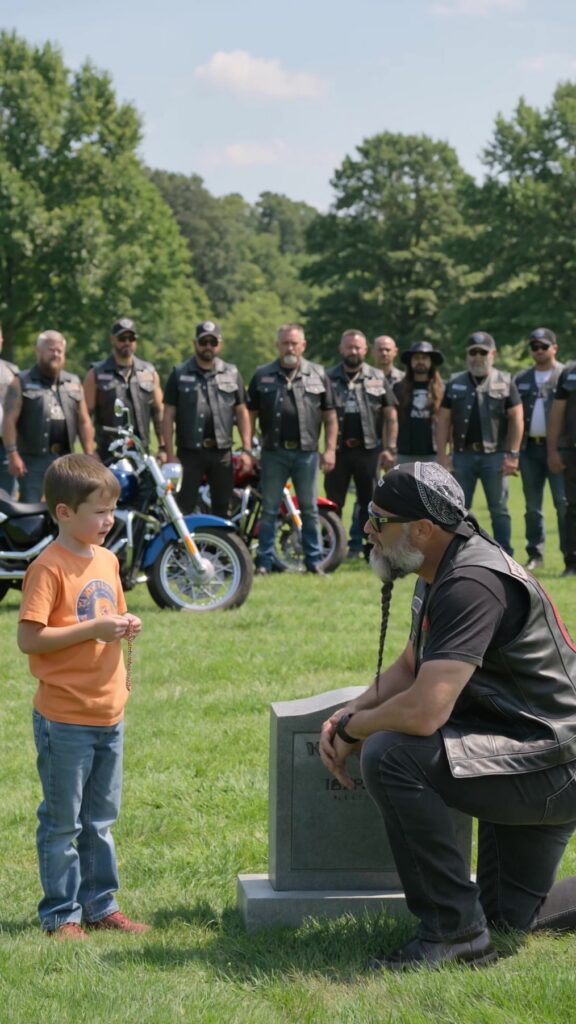
The cemetery was the kind of green that looked almost disrespectful. Like the grass didn’t get the memo that it was supposed to be sad. Sunlight bounced off chrome in little rude flashes, and a row of motorcycles sat lined up along the gravel path like they were standing at attention. Nobody revved an engine. Nobody cracked a joke. Even the guys who laughed at danger like it was a bar trick kept their mouths shut.
Rook had been the one to suggest they park in a clean line. “She liked things straight,” he’d said. Then he’d cleared his throat like he hadn’t just admitted Marina had preferences and he’d paid attention.
Clay “Graybraid” Madsen stood at the edge of the headstone crowd with his hands in his vest pockets, shoulders braced as if a punch was coming. He’d already done his crying. He’d done it in the garage, alone, sitting on an oil-stained stool with a rag in his hands and no bike to wipe down. He’d done it outside the hospital when they told him they’d found a body but couldn’t swear it was hers until dental records came back. He’d done it the day they put a plain gray marker in the ground because nobody could agree on a name that didn’t invite questions.
He’d told himself the tears were a debt paid in full. Tears were for men who still believed they could fix something by being sad enough.
Then he saw the kid.
A boy, maybe eight or nine, stood a few steps away from the stone. Orange shirt. Too bright for a funeral, too bright for this club’s color palette of black leather and bruises. His hair stuck up in the back like he’d slept in a car. He didn’t look around at the motorcycles. He didn’t flinch at the heavy boots behind him. He just stared at the marker like it had stolen his air.
And in his hands—held carefully, like a tiny animal he was afraid to startle—was a beaded necklace.
Not just any necklace. Marina’s.
Worn beads in colors that didn’t match anything on earth—dark river-green, faded amber, smoky blue—and one little metal charm shaped like a star that had been bent once and never quite straightened again. She wore it when she rode. She wore it when she stitched cuts at the clubhouse table with a headlamp on. She wore it the night she vanished, leaving behind a half-finished cup of coffee and a door that had been shut so softly nobody heard it.
Clay’s lungs forgot how to work.
His boots moved on their own, crunching gravel, and the bikers behind him shifted as if to follow, then stopped when they realized where he was going. Clay dropped to one knee in front of the boy, the motion stiff and sudden, like his body was old even if his pride wouldn’t admit it.
“Hey,” Clay said, but it came out rough. “Where’d you get those?”
The boy’s fingers tightened around the strand. His knuckles went white. His eyes were wide and shiny, the kind of shine that means the tears didn’t just happen—they’ve been waiting, stacked up behind a dam.
“She gave them to me,” the boy whispered.
Behind Clay, someone sucked in a breath. Rook muttered something like a curse, but it sounded more like a prayer.
Clay tried again, slower this time. “Marina gave you that necklace?”
The boy nodded once, quick and hard, like the nod itself hurt. “She said I had to hold it. In case she didn’t come back.”
Clay swallowed and tasted dust. He wanted to ask a hundred questions at once—when, where, why, how—but his voice chose one and dragged it out like it weighed a ton.
“What’s your name, kid?”
The boy hesitated. He glanced at the headstone. Then back at Clay’s face, like he was trying to match him to a picture in his head. “Eli.”
Clay’s throat tightened. It wasn’t the name. It was the way the boy said it, like it didn’t feel permanent yet.
“Eli,” Clay repeated, softening it. “How do you know Marina?”
Eli’s mouth trembled. He looked like he was deciding whether to run or collapse. “She… she was my Marina.” He sniffed hard, angry at his own nose. “She told me to come here and wait.”
Clay’s heart thumped against his ribs, too loud. “Wait for who?”
Eli stared at the braid hanging over Clay’s shoulder, gray woven with habit and time. “For the man with the gray braid,” he said. “She said you’d know what to do.”
For a second, the world went very still. Even the distant traffic noise faded like somebody turned down a dial. Clay felt the eyes of the club on his back—men who’d fought in alleys and deserts, men who’d buried brothers without blinking—and he knew every single one of them had just felt the same chill crawl up their spine.
“Okay,” Clay managed. “Okay. I’m here.”
Eli’s lower lip quivered. He dug into his shorts pocket with his free hand and pulled out a paper folded so many times the creases looked like scars. He held it out like it might burn him.
Clay took it carefully, fingers suddenly clumsy. Unfolding it felt like opening a trap.
The handwriting was Marina’s. Not the neat, public handwriting she used on first-aid labels, but the quick slant she used on sticky notes and secrets. Clay read the line once, then again, because his brain refused to accept it as real.
He must never learn whose son.
Clay’s hand started to shake. He didn’t notice at first. He noticed when the paper rustled like a leaf in wind that wasn’t there.
He looked at the bottom of the note. Her name, a small loop of a signature like a final wink.
He felt his face do something unfamiliar—like it was trying to hold itself together and failing. That old promise, the one he’d made to himself about last tears, cracked right down the middle.
Eli watched him with frightened patience. In that stare was something Clay had tried to forget. A shape to the eyes. A stormy gray-blue that didn’t belong to the boy’s sun-brown skin. Eyes that had looked at Clay from across a bar once, years ago, when Marina was still new to the club and fearless enough to call him out on his nonsense.
Clay’s voice came out thin. “Where is she, Eli?”
Eli shook his head. Tears ran down his cheeks now, hot and silent. “I don’t know. She left me with a lady named June. June said Marina was doing something so nobody would hurt me. Then June got scared. She drove me here this morning and told me to do what Marina said. June said if I saw bikes, I shouldn’t run. She said you’d be… you’d be the safest person I could find.”
Safe. Clay almost laughed, but it got stuck behind grief. He’d done plenty of bad in his life. He’d protected Marina when he could, failed her when it counted, and now a kid was standing here with her necklace like a baton passed in the middle of a race nobody wanted.
Rook stepped forward, slow. “Clay,” he said carefully, like speaking too loud might snap something. “You want us to—”
Clay held up a hand without looking back. His eyes stayed on Eli. “You hungry?” he asked the boy, because it was the only normal question in a world that had gone sideways.
Eli blinked. His tears paused mid-fall, confused. Then he nodded, small.
Clay reached out, hesitated a fraction of a second, then laid his palm on the boy’s shoulder. Eli didn’t flinch. He leaned in like he’d been carrying a weight for days and had finally found somewhere to set it down.
Clay closed his eyes. A tear slid out anyway, stubborn and traitorous. He let it.
“Alright,” he said, voice steadier now, like a man picking up a tool he knows how to use. “We’re gonna get you fed. Then we’re gonna figure out what Marina was doing, and why she thought the truth could kill you.”
He glanced at the gray stone, then at the beads in Eli’s hand. The charm caught the sunlight and flashed like a signal.
“And kid,” Clay added quietly, “you don’t have to wait alone anymore.”
Behind them, engines stayed silent, but the club moved closer all the same—forming a loose, protective circle that didn’t feel like a threat for once. Clay stood up with Eli beside him, the note burning in his pocket like a live coal, and he realized something he hadn’t let himself believe since the night Marina disappeared.
This wasn’t the end of her story.