The first rule of working the Marrow House was simple: keep moving, keep smiling, and never—ever—touch anything that cost more than your family car. Especially not the piano.
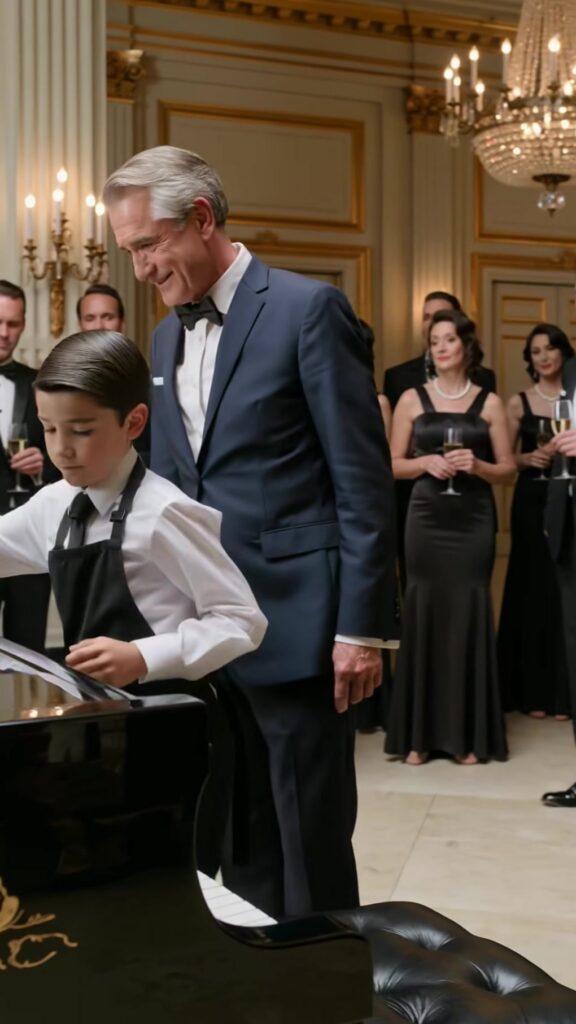
The piano sat on a little platform like it had its own zip code. Black lacquer, lid propped open, guts shining gold. People drifted around it with the careful respect they reserved for things they didn’t understand but wanted photographed near. A man in a navy suit stood closest, silver hair combed back like he’d argued with a mirror and won. Guests kept calling him “Maestro” even though nobody could name what he’d conducted lately.
Jules kept his eyes down, the way his dad taught him. His dad—Luis—worked these galas as a waiter, and Jules was there because school was out and babysitters were expensive. “You carry the tray, you do not get curious,” Luis had warned, tying a black apron around Jules’s waist with a knot that meant business. “Curiosity is what gets people noticed.”
Getting noticed, at Marrow House, was dangerous. Jules didn’t fully understand why, but he understood the tone. When his dad said it, his voice got flat, like a door closing.
So Jules floated through the ballroom with a tray of champagne flutes, a white shirt that pinched his shoulders, and a tie that made him feel like he was impersonating a grown-up. The room was all crystal chandeliers, perfume, and the soft sound of rich people laughing at jokes that weren’t funny.
At first, nobody noticed the kid. They never did. They saw the uniform and assumed the person inside it came with no story. Jules actually liked that part. Invisible was calm.
Then a woman in a sequined dress snapped her fingers at him without looking. “More bubbles.”
He nodded, polite, and pivoted toward the bar—except his eyes snagged on the piano like a loose thread. He didn’t mean to look. It just happened. The instrument wasn’t supposed to feel like anything. It was furniture. It was decoration.
But something in his chest pulled tight, like the room had suddenly changed temperature.
He’d seen a piano once before. Not like this. A battered upright in the back of a community center, keys chipped, middle C stuck if you hit it too hard. His mom—when she was still around—used to press his hands to it and laugh when he tried to copy her. “Soft, Jules,” she’d say, guiding his fingers. “Let it breathe.”
He hadn’t thought about her in weeks. Not on purpose. Thinking about her was like poking a bruise.
He told himself to keep walking. He really did. But his feet slowed anyway as he passed the platform. He could see the polished lid reflecting the chandeliers like scattered stars. He could almost smell old wood and dust and the faint metal tang of strings.
The navy-suit man was talking to someone about “standards” and “taste” and “modern mediocrity.” Jules didn’t know why, but the man’s voice made his teeth itch.
Jules stopped. The tray felt suddenly heavy in his hands.
He looked up at the silver-haired man and heard his own voice come out calm, like it belonged to someone else. “Sir,” he asked, “may I play this?”
It was like somebody hit pause on the room. Not total silence—there were still tiny noises, a cough, the clink of glass—but the energy shifted. People leaned in with that hungry expression they got right before a kid face-planted at a recital.
The man gave Jules a quick once-over: apron, tray, cheap shoes. A smile tugged at his mouth, amused and careless. “Sure, kid,” he said, waving a hand. “Go ahead.”
Jules set the tray down as gently as he could. His hands were steadier than his stomach.
He sat at the bench, which felt too big, like it was built for someone who took up more space in the world. He put his fingers on the keys and hesitated. He wasn’t planning to do this. He didn’t even know what he was going to play.
Then, without warning, his hands moved.
The first notes came out bright and sharp, like the air had been split open. The sound wasn’t just loud—it was awake. It spilled across the ballroom and made people turn their heads like they’d heard their name.
Jules didn’t see them anymore. The room blurred. The piano was the only real thing.
The music that poured from him wasn’t the community center stuff. It wasn’t the little tunes he’d taught himself when he couldn’t sleep. It felt older. Complicated. It ran fast, then sank into something dark and aching, then snapped back with a glittering, almost angry joy. Jules’s fingers flew, and he wasn’t thinking about the next note—he was already there, as if the piece lived in his bones and had been waiting for permission to speak.
Conversation died mid-laugh. A server froze with a bottle tilted in the air. Someone’s phone slipped out of their hand and thudded onto the carpet. Nobody cared.
Jules heard a sharp inhale from somewhere close. The navy-suit man had stopped smiling.
By the time Jules reached the middle section—where the melody turned on itself, twisting like a rope—he felt a hot sting behind his eyes. The music was pulling images out of him: his mom’s hands, the way she hummed when she cooked, the night she left and his dad sat on the couch staring at nothing with a letter crushed in his fist.
The final run rose like a dare. Jules hit the last chord hard enough to make the strings ring longer than they should have.
Silence slammed down. Not polite silence. Not “bravo” silence. The kind where nobody remembers how to move.
Jules lifted his hands off the keys and stared at them like they belonged to a stranger. His heart was hammering. He suddenly remembered: he was not supposed to touch the piano.
Then the silver-haired man stepped forward, slow, like he was afraid the moment would break. His eyes shone. He looked less like a wealthy guest and more like someone who’d been lost for a long time and just recognized a street sign.
“Where did you learn that?” he whispered.
Jules swallowed. “My mom.” The words came out small. “A long time ago.”
The man’s jaw tightened. He leaned closer, voice shaking. “That piece… it was never published. It was played once. In private.” He pressed a hand to the edge of the piano, knuckles pale. “I wrote it.”
Jules blinked. “You—?”
“For her,” the man said, and there was no need to explain who “her” was. The way he said it made the air feel crowded. “I’ve been looking for her. For years.” His eyes locked onto Jules’s face with terrifying certainty. “And for you.”
The crowd stirred, confused. Someone whispered, “Is this part of the entertainment?” Another person laughed nervously and stopped when nobody joined in.
From the edge of the room, the floor manager—Tressa, the woman who barked orders at staff like a drill sergeant—went pale. She dropped a tray. Glass shattered. The sound snapped everyone’s attention toward her, and she didn’t look surprised.
She looked scared.
Tressa pushed through the guests fast, face tight. She grabbed Jules by the arm, fingers digging in hard enough to hurt. “No more,” she hissed, low and urgent. “We’re leaving. Now.”
Jules stared at her. “What—?”
“He can’t know,” Tressa said, voice cracking. “You don’t understand. You cannot let him say her name out loud in this house.”
The navy-suit man straightened, anger flickering across his grief. “Who are you to—?”
“Someone who cleans up the mess after men like you make decisions,” Tressa shot back, then leaned down to Jules, softer but frantic. “Your dad told me to keep you invisible. He said if you ever got near that piano, it meant she’d found you first.”
Jules’s stomach dropped. “My dad said that?”
Tressa tightened her grip and pulled him off the bench. Jules stumbled, looking back at the keys like they were a doorway he’d accidentally walked through.
The silver-haired man took a step after them. “Wait,” he said, and the single word carried money and authority and something desperate underneath. “Tell Luis I’m done waiting. Tell him I want my family back.”
Jules turned his head, his arm still in Tressa’s grasp. “You knew my dad?”
The man’s gaze didn’t leave Jules’s face. “I know he’s been hiding you.”
Tressa yanked Jules toward the service hall. The ballroom lights fell behind them, replaced by the dim, utilitarian glow of the staff corridor. The music still echoed in Jules’s ears, like it had branded him.
Down the hall, Jules saw his dad rounding the corner with a stack of plates. Luis’s expression changed the instant he saw Jules—changed into something Jules had never seen on his father’s face before.
Fear, clear and sharp.
“Jules,” Luis said, voice tight. His eyes flicked past him, toward the ballroom. “Tell me you didn’t.”
Jules opened his mouth, and the only honest answer sat there like a stone. “I did,” he said. “Dad… he said he wrote it. He said it was for Mom.”
Luis closed his eyes for half a second, like he was bracing for impact. When he opened them, he didn’t look angry. He looked tired in a way that made Jules’s throat burn.
“Yeah,” Luis said quietly. “That’s why you were never supposed to touch the piano.”
Behind them, the muffled sound of the ballroom returning to life drifted through the door—people talking, speculating, trying to turn something real into gossip they could carry home.
But in the hallway, Luis set the plates down with shaking hands and knelt so his face was level with Jules’s. “Listen to me,” he said. “Whatever happens next, you stay close. No secrets. No solo acts. That music… it’s a map. And you just showed him you exist.”
Jules felt the weight of that land on his shoulders, heavier than any tray. “I didn’t mean to,” he whispered.
Luis gave a sad little exhale. “I know,” he said. “None of this was ever supposed to be yours.”
Tressa looked down the hallway like she expected someone to come charging after them. “They’ll be looking,” she muttered.
Jules stared at his father. “Where is Mom?” he asked, because if the music could drag ghosts into a ballroom, maybe it could finally drag the truth into the open too.
Luis’s mouth tightened. He glanced once toward the door, toward the piano, toward the man who had recognized a song like it was a fingerprint.
Then he said, barely above a whisper, “We’re going to find her before he does.”