The ice cream vendor forgot the little girl by the next day, which sounds cruel until you’ve worked a street cart long enough to realize days blur together like melted sherbet. You remember the rush, the coins, the sunburnt tourists asking for “the blue one,” and the constant panic of keeping the freezer cold. Faces come and go. Names almost never stick. And if you’re lucky, you make enough to buy groceries before the corner shop closes.
That afternoon, the heat had the whole town moving like it was underwater. The stone street shimmered. Pigeons were hiding. Even the church bells sounded tired. Luca—back then he was still Luca, not “sir” or “mister” or “hey, ice cream”—stood behind his cart with a damp towel on his neck and a grin he’d learned to wear like a uniform.
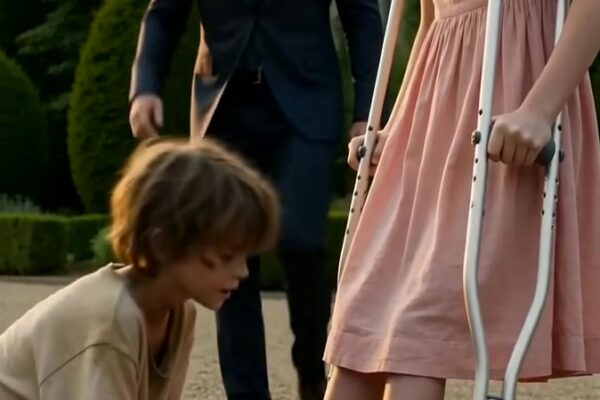
She appeared near closing, when his last batch was already starting to lose its perfect curl. A small girl, maybe seven, maybe nine. Thin as a pencil. Hair that looked like it had fought with a comb and won. A dress that had been a brighter color in another life. She didn’t step up like the other kids, all elbows and confidence. She lingered just outside the “customer zone,” staring at the swirls like they were a movie playing just for her.
Luca watched her do the thing he’d seen too many times: lift her hand, pause, drop it again, pretending she hadn’t meant to point. The kind of hesitation that doesn’t come from shyness so much as practice. He asked, “Hey, which flavor are you thinking?” in his friendly-salesperson voice.
She didn’t answer. Her eyes flicked to the little chalkboard sign where he’d written PRICES in chunky letters. Then down to her empty hands. Then back to the ice cream, like she was trying to memorize the shape for later.
Luca glanced inside the cart. He had exactly one cone left in the holder and not much product in the machine. It was the end of a rough day—actually, the end of a rough month. He was behind on rent for his tiny room, the electricity bill was taped to his door like a threat, and his stomach had been making loud, dramatic speeches since lunchtime.
He could have closed early and saved the last of it for a paying customer. He could have told her to come back tomorrow. He could have done what most people do when they’re tired and broke: nothing.
Instead, he pulled the lever and spun the soft-serve into the tallest, ridiculous spiral he could manage, the kind that makes kids gasp and adults laugh. He handed it over before she could find a reason to refuse.
Her fingers wrapped around the cone like it was fragile. She looked up at him—really looked, not the quick glance kids do when they’re already thinking of the next thing—and her mouth opened slightly, as if she couldn’t quite locate the correct word for what was happening.
“It’s a gift,” Luca said, aiming for casual. “Before it turns into soup.”
For a second she just stood there, letting the cold touch her palm. Then she nodded once, hard, like she’d made a vow. “I’m going to pay you back,” she said. Her voice was small, but it didn’t wobble.
Luca laughed because that’s what adults do when children promise impossible math. “Sure, sure. Just don’t drop it.”
She didn’t smile, not fully. She took two steps away, then turned back. “What’s your name?”
“Luca,” he said.
She repeated it quietly as if filing it somewhere safe. Then she ran, not with the careless joy of a kid with ice cream, but with the urgency of someone carrying a torch through a windy place.
By the next day Luca had forgotten her face. Not because it didn’t matter. Because the morning brought a new crowd, a new set of problems, and another bill. He remembered that he’d given away a cone—he felt that in the hollow place in his wallet—but the girl herself dissolved into the general category of “kids who deserve better.”
She, however, kept him like a secret coin in her pocket.
Years slid by in ordinary, unromantic ways. Luca’s cart got older. The paint chipped. The umbrella developed a stubborn lean. Big glossy shops opened near the plaza, offering neon flavors and discounts so aggressive they felt personal. The town changed its walking habits. People began to take alternate streets, and Luca’s corner became a place you passed through, not a place you stopped.
He tried to adapt. He added fancy toppings. He learned to make iced coffee. He even made a sign that said ARTISANAL in lettering that looked more optimistic than he felt. But some summers are just bad, and some bad summers stack on top of each other until you’re holding a tower of regret.
By the time autumn rolled in, the air smelled like wet leaves and failure. Luca sat beside his cart, staring at the empty street like it might apologize. He’d sold his watch. He’d sold his old scooter. He’d borrowed from a cousin who now wouldn’t answer calls. A friend stopped by with a cigarette and a sympathetic shrug.
“So what now?” the friend asked.
Luca exhaled and watched his breath fade. “Now I lose everything. Cart, license, room. I’ll end up sleeping under the bridge with the graffiti that says DREAM BIG.” He tried to make it a joke. It landed like a stone.
He didn’t notice the sleek black car two streets away slowing down like it had found something interesting. He didn’t notice the woman in the back seat leaning forward, eyes narrowing, as if she’d just heard a song from childhood.
Her name was Mara now. People said it with respect. She wore tailored suits and had a schedule that bullied the rest of the world into obedience. She’d built a life out of numbers and strategy and not depending on anybody. Yet the moment she saw Luca’s hunched shoulders beside that familiar cart, her chest tightened like an old bruise had been pressed.
“Stop the car,” she told her driver.
“Ms. Rinaldi, you’re due at—”
“I know what I’m due,” she said, and her voice did that thing it did in boardrooms: calm, final, impossible to argue with.
She stepped out in heels that clicked against the cobblestones like punctuation. Luca looked up, expecting a tourist asking if he was open just to be polite. Instead he saw a woman who looked like she belonged in a glass building, not in the street where the wind carried paper scraps.
“I’m closed,” he said automatically, already embarrassed by the way his hands were rough and his clothes smelled faintly of sugar that never quite washed out.
“I’m not here to buy,” she said.
He blinked. “Then…?”
Mara set something on the cart’s metal counter with careful fingers. A napkin, folded into a small square. Old enough that it had gone from white to the color of tea. She’d kept it in a plastic sleeve all these years, like a museum artifact no one else would understand.
Luca frowned and unfolded it. A few brittle sugar crystals fell onto his palm. There was handwriting in faded ink, shaky and determined: I WILL PAY YOU BACK. Under it, in smaller letters, LUCA.
His throat made a sound he didn’t approve of. “Where did you—”
“You gave me ice cream,” Mara said, and her voice finally softened. “I didn’t have money. I didn’t even have a place I was sure I’d sleep that night. But you handed me the biggest cone like it was nothing.”
Luca stared at her face, searching for the child inside it. The eyes, he realized. The same seriousness. The same way of looking like she was collecting details for later.
“I’m sorry,” he said, because his brain, overwhelmed, picked the wrong sentence. “I don’t remember. I mean—I remember doing it, maybe, but not you.”
Mara nodded as if she’d expected that. “You forgot me by the next day. Of course you did. You had bills and a life and a stomach to feed.” She swallowed, and for a second the polished executive slipped, revealing a woman holding something tender. “But I never forgot you. Not the cone. Not your name. Not the fact that you closed early that day because you’d given away the last one.”
Luca’s eyes stung. “How would you know that?”
“Because I came back,” she said quietly. “The next morning I had two coins I’d found in the couch of the place I was staying. I ran to your corner, and you weren’t there. Later I heard the shopkeeper say you’d gone home early because you hadn’t sold enough for dinner.” She let out a breath, sharp with old anger at the world. “That got stuck in my head. Kindness with a cost. People don’t forget that.”
Luca sat down hard on the little folding stool, as if gravity had suddenly doubled. “So why are you here?”
Mara looked at the cart—the chipped paint, the tired umbrella, the sign trying its best. Then she looked at Luca. “Because I heard you’re about to disappear,” she said. “And I don’t like unfinished promises.”
She opened her handbag and pulled out a slim folder. Inside were documents, crisp and confident. A lease renewal. A business partnership agreement. A new permit application already filled out. There was even a rendering—an updated cart design that still kept the pastel charm, just… sturdier. Like it could survive the future.
Luca’s mouth opened, then closed. “I can’t afford this.”
“You’re right,” Mara said. “So don’t ‘afford’ it. Accept it.” She tapped the napkin. “Consider it interest.”
Luca looked at the papers like they were written in another language. “What do you get out of it?”
Mara shrugged, and for the first time she smiled the way she probably had wanted to all those years ago. “I get to sleep at night without hearing my own seven-year-old voice telling me I owe someone. Also, I’m not going to lie—I want this cart to stay. Some things are supposed to remain in a town, like the fountain and the crooked clock tower.”
He laughed, a broken little sound that turned into something real. “You’re serious.”
“Painfully,” she said.
Luca stared at her, then at the street around them, as if expecting the whole scene to be a prank. But the napkin was real in his hand, the sugar crystals catching light like tiny stars. He looked up again, and his voice came out rough. “What do I call you?”
“Mara,” she said. “But once, I was just a kid with messy hair and a dress that didn’t fit. And you made me feel… seen.”
Luca nodded slowly. “All right, Mara,” he said, tasting the name like a new flavor. “Let’s figure out how to keep the freezer cold.”
She extended her hand. He took it, his palm still smelling faintly of vanilla and old summers. And for a second, the street didn’t feel like a place where people got forgotten. It felt like a place where, sometimes, they came back.