For years, Damian Laurent had lived like a man who could not be interrupted. Interruption was for ordinary men—men who waited in lines, who apologized when they bumped shoulders, who owned the kind of lives a stranger could tap with a question and not risk a bruise.
Damian’s life was engineered against surprise. A phalanx of bodyguards. Tinted windows. Assistants who filtered calls like seawalls. Invitations that arrived already stamped with his name as though the world itself had issued them. People felt him coming the way birds sensed a storm and scattered before the pressure dropped.
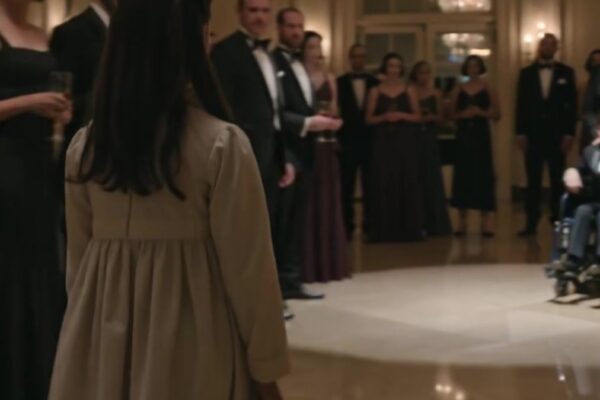
On a wet Thursday in late autumn, the city was a bruise of slate and neon. Damian’s driver had stopped two blocks from the Laurent Foundation’s gala venue to avoid a march clogging the main avenue. Damian stepped out anyway, impatient with the idling and the smell of leather warmed by his own anger.
The sidewalk seethed with commuters. His security moved ahead and behind him in a practiced pattern, clearing a lane with polite menace. Damian was already rehearsing the evening: the photographs, the speeches, the careful generosity that made headlines without bleeding too much money.
Then an old woman on the curb lifted a violin and aimed it, impossibly, directly at him.
Irritation hit first, hot and automatic. Street musicians were everywhere. The city was full of people who believed their hunger was a performance the rich were obligated to clap for. Damian did not stop for them. He had built his whole adulthood around not stopping.
The bow trembled as it met the strings.
The melody that came out was thin, almost swallowed by traffic—two notes, then a third that wavered as though the instrument itself were cold. It was not a showpiece. It did not beg. It simply existed, delicate and stubborn, insisting the air make room.
Damian halted so abruptly his nearest guard nearly collided with him. The sudden stop was a physical betrayal; his body had decided before his mind could veto it. He felt the sound in his chest like a key turning somewhere he had bricked over.
The woman’s hands shook, but her gaze did not. Her coat was layered and tired, stitched at the elbows with mismatched thread. Beside her sat an open case with a scatter of coins—offerings from people who had not understood what she was playing at. Her eyes were fixed on Damian with a terrible, pleading precision.
“Sir,” she said, voice ragged from the cold. “Just one song.”
Damian lifted a hand, sharp as a knife. “Not today. Stop.”
The bow scraped, producing a brief, ugly squeal—an accident born of age, numb fingers, or the tremor of fear. And then, as if she were making one final attempt to be heard, she released one last soft note, almost too pure for the street.
That note split him.
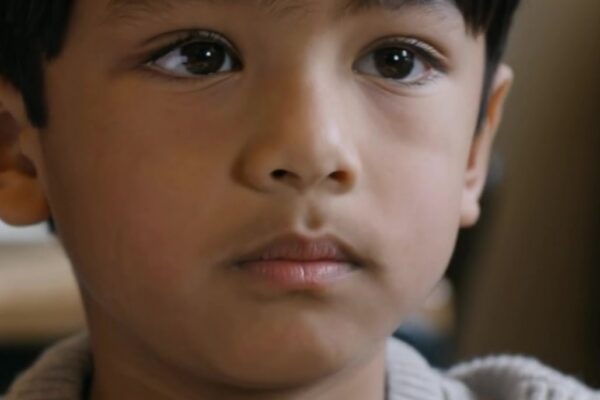
He was not on the sidewalk anymore. He was small, fevered, floating in the damp heat of a childhood bedroom. A lamp glowed amber beside his bed. A woman sat near him with a violin tucked under her chin, her hair coming loose from its pins. She played that same fragile melody, and between notes she leaned down to push sweat-damp hair away from his forehead.
“Again,” the boy whispered.
“Always,” the woman replied, and her smile was the whole world.
The vision snapped back like a rubber band. Damian was a man again, surrounded by people and noise. His jaw had loosened. A tear had already formed and begun its humiliating path down his cheek before he realized he was crying.
The woman lowered the violin a fraction. Her breath shuddered. “You remember it,” she said.
“No,” Damian answered too quickly, the word coming out like an order to his own body. “I don’t.”
“Look at me.”
He didn’t want to. Wanting had never been the issue. He could feel that if he truly looked, the life he had curated would crack like glass under a sudden temperature change. He had survived by believing certain things were fixed: his lineage, his loss, his father’s version of the past.
But his eyes disobeyed.
It wasn’t the logic of resemblance. It was something older—recognition stitched into muscle and bone. The shape of the mouth. The slope of the cheek. The particular sorrow in the eyes that did not blink when the world went hard.
She lowered the violin fully, clutching it against her chest as though it might protect her. “I played it for you every night,” she said, and her voice broke on the last word. “My son.”
Damian’s guards went still. One of them touched the earpiece in reflex, but he didn’t speak. Even they seemed to sense this was not a threat that could be tackled.
Damian forced air into his lungs. “My mother is dead.”
The woman’s lips trembled. “That is what they told you.”
His heart tightened until it hurt. He was six when it happened—when the house filled with whispering staff, when doors were shut and curtains drawn, when his father carried him past a room that smelled like lilies and said, in a voice like marble, that his mother had gone away.
No viewing. No funeral crowds. A private burial. The story presented to the world with the Laurent stamp of finality. Damian had been taught that grief was something you carried in silence, like a family crest.
Now this woman stood in front of him like a ghost that refused to behave.
She reached inside her coat with stiff fingers and brought out a cloth bundle tied with faded gold thread. Her hands were shaking badly now, but she worked the knot loose with stubborn patience, as though she had untied it a thousand times in her mind.
Inside were three objects: a small wooden horse with one ear chipped; a silver button etched with a crest Damian recognized from old photographs of his childhood coats; and a photograph worn soft at the edges.
Damian took the photograph as though it might burn him. A young woman sat beside a child’s bed, violin in her lap. Her head was turned toward the boy, smile mid-bloom. The boy under the blanket was Damian—same scar at the brow from the time he’d fallen against a fireplace grate, same hand clutching the sheet as though it were the last steady thing in the world.
His breathing stopped. “What happened to you?” he managed, the words barely audible.
Before she could answer, tires hissed against wet pavement. A black luxury car slid to the curb with the abrupt certainty of authority. Its rear door opened with a quiet, practiced click.
Damian turned—and felt the street tilt beneath him.
His father stepped out.
Lucien Laurent wore a charcoal coat cut so perfectly it looked like it had grown on him. His silver hair was combed back, his face composed in the way of men who believed emotion was a flaw to be corrected. He looked, at first glance, like a man arriving to solve a minor inconvenience.
Then Lucien’s eyes landed on the violin.
The change was small, almost imperceptible—an infinitesimal tightening around the mouth, a fraction too much white showing under the iris. But Damian had spent a lifetime reading his father’s microexpressions the way sailors read the sea. This was not confusion. This was not surprise.
This was fear.
The old woman’s body went rigid as well, as though the cold had suddenly deepened. She clutched the violin to her ribs. The bow hung from her fingers like a dropped weapon.
Damian looked between them, his stomach hollowing. “You know her,” he said, and it was not a question.
Lucien’s jaw flexed. He didn’t glance at the guards; they were already moving into position, creating a discreet barrier between the scene and the public. “Get in the car,” Lucien said, his voice calm enough to be cruel.
The woman took one step back. “Tell him,” she demanded, and the tremor in her voice was not weakness but fury that had survived famine. “Tell him the truth.”
Lucien advanced a single step, and the air around him seemed to tighten. “You are unwell,” he said, the words clipped. “You should have stayed out of sight.”
Stayed out of sight.
The phrase struck Damian with the force of a blow. It implied planning. It implied instructions. It implied that this woman’s existence had been managed like a scandal.
The old woman laughed once, a sound threaded with tears. “Ask him,” she whispered to Damian, eyes burning bright, “why he paid for an empty coffin and told his son I was inside it.”
The street noise fell away. Damian heard only his own pulse, loud and frantic, as if trying to escape his body.
He turned fully toward his father. Lucien’s composure held, but it was the composure of a man standing in front of a door he had nailed shut long ago, hearing the nails begin to pop.
Damian’s voice came out low. “Was there a coffin?”
Lucien’s gaze flicked to the photograph in Damian’s hand. For the first time, something like disgust crossed his face—not for the woman, but for the evidence. “Damian,” he said, and the use of his name sounded like an attempt to reclaim possession. “This is not the place.”
“Was there a coffin?” Damian repeated, louder now.
Lucien’s eyes hardened. “Get in the car.”
Damian realized, with a clarity that made him nauseous, that his life had always been interruption-proof because his father had designed it that way. Bodyguards weren’t only for protection; they were walls. Black cars weren’t only convenience; they were moving blindfolds. The name that opened doors also closed mouths.
The old woman lifted her chin, the violin tight against her heart. “I did not die,” she said, each word shaped carefully. “I was erased.”
Damian stared at his father—at the man who had taught him the language of power, who had handed him a world wrapped in luxury and told him it was love. “Why?” he asked, and the question was so simple it was devastating. “Why would you do that?”
Lucien’s answer did not come. Not in words. It came in the small, involuntary flinch he couldn’t quite control when the woman’s bow scraped the pavement.
Damian looked at her again. Her eyes were wet but steady, as if she had spent years rehearsing this moment in the dark. “What did he do to you?” Damian whispered.
She opened her mouth—and before she could speak, Lucien’s hand came up in a sharp gesture to the nearest guard, a command for motion, for removal, for silence. The old machinery of the Laurent family began to grind into action.
Damian felt something in him shift, not break this time but lock into place.
For years, he had lived like a man who could not be interrupted.
Now, with a violin’s last note still vibrating in his bones, he understood the real tragedy: he had been living like a man who had been trained not to listen.
He stepped forward—not toward the car, but toward the woman—and the first true interruption of his life became an act of defiance.
“No,” Damian said, voice steady as he raised the photograph like a shield. “We’re doing this here.”