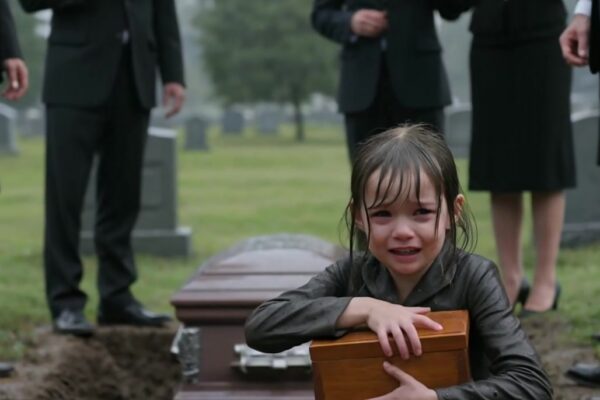
The morning the verdict was meant to fall, the courthouse smelled of wet stone and old paper. Rain had followed everyone inside, clinging to hems and shoulders like a second skin. In the front row, cameras clicked in nervous bursts; on the bench, the judge’s gavel lay like a sealed promise. People had come to watch a maid be buried—if not in earth, then in words that would ruin her life.
Elsie Marrow stood at the defense table in a borrowed black-and-white uniform that was too stiff at the collar. Its neatness looked like an insult beside the accusations. She kept her eyes on the grain of the wood in front of her, as though staring hard enough could make it split open and swallow her whole. For three weeks they had called her a thief, a schemer, a girl who tried to crawl above her station by taking what glittered. They had said she had blood on her hands and greed in her heart.
She had not denied everything. She had denied only what she could. That was the problem.
On the witness bench sat the boy, the smallest body in the room and the heaviest silence. Henry Ainsley’s gray suit had been tailored to make him look older, but the sleeves still swallowed his wrists. His feet didn’t reach the floor. He had been placed there like a ceremonial object—evidence in the shape of a child. He stared straight ahead, hands folded too tightly in his lap, knuckles pale. Every so often his fingers twitched as if he were holding on to something invisible that wanted to run away.
“The court has heard ample testimony,” the prosecutor said, voice smooth and certain, “that the defendant had motive, opportunity, and access. The missing bracelet was found in her apron pocket. The victim’s study showed signs of struggle. The household staff attest to her resentment. We ask you to find her guilty.”
Elsie’s lawyer made a final plea that sounded like wind against a locked door. “She has served that family since she was sixteen. The item was planted. She had no reason to—”
Across the aisle, at the polished table of the complainant, Helena Ainsley sat as if carved from calm. Black lace gloves covered her hands. The hat she wore dipped just enough to shadow her eyes, not enough to hide them. She watched without blinking. Beside her sat her husband’s elder brother, Mr. Conrad Ainsley, a man whose posture was an argument all by itself. He had delivered his testimony with the neatness of a blade: Elsie was untrustworthy; Elsie was ambitious; Elsie had been seen near the study that night.
The judge lifted the case file. “Before I instruct the jury—”
A chair scraped.
The sound was tiny, but it tore through the room. All heads turned.
Henry was standing.
For a heartbeat nobody moved, as if the air itself had forgotten how to behave. The bailiff took a step, then stopped at the judge’s raised hand. Henry’s knees trembled. His mouth opened, closed. His eyes were fixed on a point beyond the maid, beyond the jurors, beyond the easy conclusions people loved.
“Henry,” Helena murmured, her voice a soft warning wrapped in silk. “Sit down.”
He did not sit.
He lifted his arm, and his hand shook so hard the cuff of his jacket fluttered. His finger extended like a compass needle finding north. “It wasn’t her,” he said. The words came out thin at first, then stronger, like someone turning up the volume on a radio. “I saw everything.”
A ripple of gasps ran through the benches. Reporters paused mid-scribble. The jurors leaned forward, their certainty suddenly unstable.
Elsie looked up. Her eyes, red-rimmed from nights without sleep, widened as if she’d been struck. She hadn’t dared hope for rescue, least of all from the child whose life she’d tried to keep untouched by the ugliness of adults.
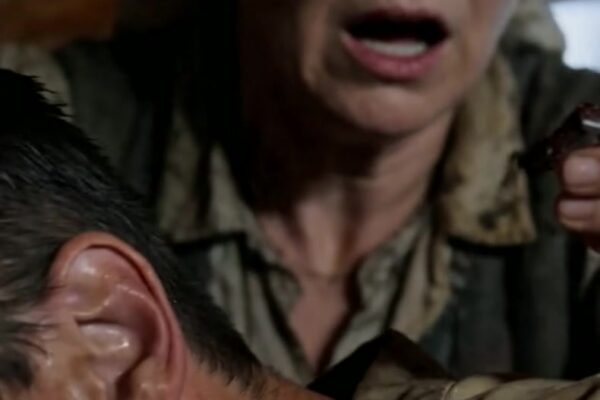
“Henry,” Conrad snapped, already rising, his chair thumping. He crossed the aisle with the speed of a man used to taking things. His hand clamped down on the boy’s forearm, too hard, too possessive. “This is not your place.”
Henry winced, but he didn’t lower his arm. His small shoulders tightened as if bracing against a storm. “Stop,” he said, voice cracking. “You’re hurting me.”
“Mr. Ainsley,” the judge barked, gavel striking once. “Release the witness. Now.”
Conrad’s fingers loosened reluctantly, as if letting go of something he considered his property.
Henry drew in a breath that shuddered in his chest. “She was protecting me,” he said, and his gaze flicked to Elsie for the first time. “She told me to be quiet. She told me to hide.”
Elsie’s throat closed. She remembered the night in the Ainsley house—remembered the storm rattling the windows, the taste of iron in the air that hadn’t been there before. She remembered Henry’s bare feet on the corridor rug, his sleep-blurred face turning sharp with fear when he heard shouting from the study.
She had shoved him gently behind the staircase, pressing a finger to her lips. Stay. Don’t come out. Whatever you hear, don’t move.
She remembered stepping between him and the railing, blocking his view with her body, pretending she was only a maid straightening a runner when inside she was a wall built of panic.
She remembered the glint—something bright in a hand moving too quickly—and then the weight in her apron pocket that hadn’t been there a moment before.
In court, the prosecutor recovered first. “Henry,” he said carefully, “children can misunderstand what they see. You’re under oath. Can you tell us what you saw?”
Henry swallowed. His eyes darted over the room, as if searching for the safest place to put the truth. There wasn’t one. “I was under the stairs,” he said. “I saw the study door open. I heard yelling. Someone fell against the desk. Elsie ran in. She told me to hide. I saw a hand—” He shook his head hard, trying to dislodge a memory. “I saw someone take the bracelet and put it in her apron. And then they told her she’d ruin me if she said anything.”
Elsie’s breath hitched. That last part was what had gagged her for weeks. Not fear for herself, but fear that Henry would be dragged into scandal and cross-examination, that a child would be made to carry adult sin like a stone.
The judge’s voice sharpened. “Who is ‘they,’ Henry?”
Henry’s lips trembled. His eyes shone with tears he refused to let fall. Slowly, as if his arm were moving through water, he turned his pointing finger away from Elsie.
It swung toward the complainant’s table.
Toward the woman in the lace gloves.
Helena Ainsley did not move. Only her throat worked once, a small swallow that betrayed the first crack in her composure.
“It was her,” Henry said, and the word her landed like a stone in a pond, sending shockwaves outward. “My mother.”
A sound rose from the gallery—half gasp, half disbelief. Conrad’s face drained of color. The prosecutor’s mouth hung open, caught between procedure and the sudden threat of catastrophe.
Helena’s eyes flashed. “Henry,” she said, voice slicing through the air, “you don’t understand what you’re saying.”
Henry’s chin quivered, but he held it up the way Elsie had taught him when bullies cornered him at school. His gaze locked onto his mother’s hands. “I do,” he whispered. “I saw the ring.”
The courtroom fell so silent that the rain tapping the windows sounded like applause.
Henry took a step forward, toward the rail, toward the adults who had tried to arrange the world into a neat story. “She still has it,” he said, voice gaining force again. “Under her ring. The blood.”
Helena’s gloved hand went to her left ring finger with an instinct too quick to hide. Lace rasped over skin. For the first time that morning, her posture slipped—just a fraction—like a portrait that had been nudged off its nail.
The judge leaned forward, eyes narrowed. “Mrs. Ainsley,” he said slowly, “remove your glove.”
Helena’s lips parted, forming a protest that didn’t quite arrive. Conrad shook his head once, violently, as if denying sound could erase it. A bailiff moved closer, boots scuffing.
Elsie’s knees threatened to buckle. She gripped the edge of the table, feeling the varnish bite into her palm. Across from her, Henry stood with tears finally spilling down his cheeks, silent now that he had broken the dam. He looked terrified, not of punishment, but of what truth might do to the people he was supposed to love.
Helena rose. For a moment she seemed ready to comply, to play the role of wronged lady even under suspicion. Then her gaze flicked toward the door—measuring distance, calculating witnesses, seeing exits the way a desperate mind does.
“Henry,” she said softly, almost tenderly, “come here.”
He did not move. He backed closer to Elsie, as if the maid were the only safe thing left in a room full of polished knives.
The judge’s gavel struck again, louder. “Mrs. Ainsley, this court orders you—”
Helena’s fingers curled around the edge of the table. The lace glove trembled. Somewhere in the gallery a camera shutter clicked, capturing the instant before a life cracked open.
And in that charged silence, Elsie realized something that made her stomach turn colder than fear: the trial had never been about a bracelet. It had been about control. About who could be sacrificed to keep a family name spotless. About how easily a maid could be buried so the wealthy could pretend their hands were clean.
Henry’s small voice had not only saved her. It had set fire to the story everyone else had paid to tell.
“Bailiff,” the judge said, “ensure the witness remains protected.”
Helena’s eyes, dark and furious now, fixed on her son as if he were a stranger who had betrayed her. “You’ve made a mistake,” she hissed, the silk finally slipping.
Henry wiped his face with his sleeve, smearing tears across the gray fabric. He looked at Elsie, then back at the judge. “I didn’t,” he said. “I was just… scared.”
Elsie’s own tears came hot and sudden. She had stayed silent to protect him. He had spoken to protect her. Between them, a terrible balance had been struck—one that would demand payment from everyone who had tried to bury the truth.
Outside, thunder rolled, and the courthouse windows shook as if the world itself were leaning in to listen.