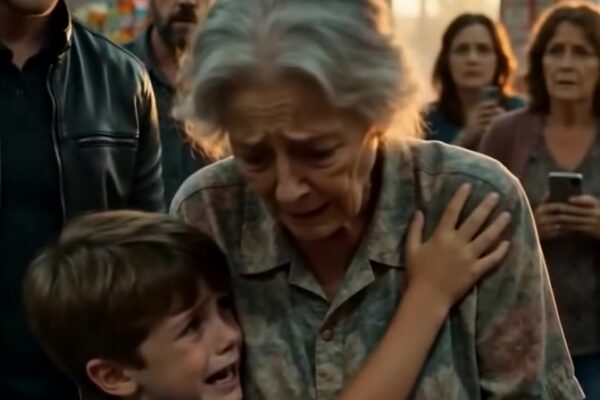
The first thing Daniel learned after the accident was that strangers offered money the way they offered prayers: quickly, clumsily, and most of all to quiet their own fear. Bills slid into his palm outside rehab centers. Envelopes arrived from coworkers who didn’t know what else to do. People said his son’s name like it was a charity event. And when none of it worked, when every specialist shrugged with careful sympathy, money became less a tool than a reminder—an expensive way of discovering limits.
That was why Daniel’s voice came out like a slap when the child approached across the park.
“We’re not giving money,” he said, stepping forward on instinct, blocking her path the way he’d learned to block everything: pity, crowds, false hope.
The afternoon had turned the grass copper. The sun hung low and sweet, making everything look gentler than it was. Behind him, Noah sat in his wheelchair as if he belonged there, his legs covered by a gray sweater despite the warmth. The sweater wasn’t for cold. It was for dignity—something you could wrap around a body that no longer behaved.
The girl in the brown hoodie stopped. She was small, maybe nine or ten, with hair pulled back as if she’d done it herself without a mirror. Her shoes were scuffed, her sleeves too long. She didn’t look at Daniel.
She looked at Noah.
“I’m not asking,” she said softly, “for money.”
Noah’s eyes lifted, cautious and bright in the way Daniel had come to fear. Hope had a particular shimmer in his son—beautiful, immediate, and always followed by the slow dimming when reality refused to bend. Daniel had watched it happen through therapies and gadgets and promises, each one a new rise and fall. He had started to hate the rise.
“Then what?” Daniel demanded, already regretting his own harshness and still unable to soften.
The girl took one more step, enough that Daniel could see her freckles, the faint bruise on her cheek like someone’s hand had been careless. She held her hands up, palms open, as though showing she carried nothing.
“I want to help him walk,” she said.
A laugh scraped up Daniel’s throat, thin and ugly, but he swallowed it. Cruelty didn’t have to be intentional to be cruelty. “Sweetheart,” he said, fighting for calm, “we’ve tried—”
“I know,” she interrupted, still not looking at him. “You tried what people sell.”
Noah blinked. “You know me?” he asked.
The girl’s gaze softened. “Not you,” she said. “What took you.”
Daniel felt his shoulders tighten. Parents of disabled children learned to read danger from small shifts: a too-friendly stranger, a camera angled from a distance, a tone that sounded like a story being harvested. He reached for the wheelchair handle, ready to roll Noah away.
Then the girl extended her hands toward Noah’s. She didn’t grab. She waited, offering. It was the gesture of someone who had been told no often and had learned patience the hard way.
Noah glanced back at his father, asking permission without words.
Daniel started to say no. The word hovered, ready, practiced.
And then he saw something in the girl’s face that made the word stick—an exhaustion that didn’t belong to a child, a steadiness that felt almost… rehearsed. As if she had been walking toward this moment for a long time.
“Fine,” Daniel said, tight. “But—”
Noah placed his hands into hers.
Nothing flared. There was no theatrical hush, no wind curling dramatically through the trees. The park went on being a park: distant laughter, a dog barking, a bicycle chain clicking. Yet the air around them changed in a way Daniel could not name—like pressure before a storm, like the world leaning closer.
The girl lowered her voice. “Just feel your feet,” she whispered, not as instruction but as remembrance. “Like they’re yours.”
Noah’s mouth parted. His fingers tightened around hers. Daniel saw the muscles in Noah’s calves twitch, a small ripple beneath fabric, so subtle it might have been imagination if Daniel hadn’t spent years staring at those legs for signs of anything.
Noah’s shoes pressed into the grass.
His knees trembled as though they were waking from sleep. His torso pitched forward, not collapsing but gathering itself, searching for balance the way a newborn searches for breath. Daniel moved instantly, hands up, ready to catch him, terrified of a fall that would shatter bones already fragile from disuse.
But the girl didn’t yank or hoist. She didn’t strain.
She pulled upward as if she were guiding a curtain to rise, slow and steady, as if the movement belonged to Noah and she was merely reminding him of the cue.
And then—
Noah stood.
The world narrowed to one impossible image: Noah upright, shaking, his shadow long on the grass. His eyes were wide with raw, stunned joy, the kind that didn’t know how to fit inside a body. Tears welled and spilled before he even spoke.
“Dad,” he breathed. “I’m— I’m standing.”
Daniel’s lungs forgot their rhythm. His vision blurred. He dropped to his knees without deciding to, as if gravity had rearranged itself around that single word. The park tilted, gold light spilling across Noah’s face like a blessing. Daniel reached out and touched Noah’s ankle, then his calf, needing proof it wasn’t a trick of sunlight.
Muscle. Weight. Warmth.
Real.
Daniel looked up at the girl, ready to thank her, to demand answers, to swear he would give her anything she wanted—money, houses, his own heartbeat—
And he stopped.
She was crying.
Not the delighted sobbing of someone witnessing a miracle.
Something harder. Familiar. Like recognition. Like grief that finally had a place to land.
Daniel’s skin went cold in the heat. He studied her face with the precision of someone searching through a locked drawer in his memory. The eyes were too old. The set of her jaw was too deliberate.
He had seen something like it before.
A hospital corridor, years ago, the smell of disinfectant and burnt coffee. Daniel’s hands shaking as he signed forms he didn’t understand. Security escorting a woman out—a woman with hospital tape on her wrist and rage in her voice. She had lunged toward him, seized his sleeve with fingers like claws, and hissed a sentence that Daniel had tried to bury for his own survival.
Your son was never meant to heal.
He had convinced himself it was grief speaking through a stranger’s mouth. A hallucination made of guilt.
Now the girl’s face pulled that memory up like a hook through water.
Daniel rose slowly, knees unsteady. “Who are you?” he asked, the words suddenly thin.
The girl released Noah’s hands. Noah wobbled but stayed upright, his arms floating at his sides like he was learning the shape of balance. He stared between them, breath quick, joy turning cautious at the shift in Daniel’s tone.
The girl dropped her gaze for a heartbeat, as if bracing herself against the weight of what she carried. When she looked up again, her eyes held Daniel with a calm that didn’t belong in playground light.
“My mother,” she said, “told me to find you when the sun looked like this.”
Daniel’s throat tightened. “Your mother?”
The girl nodded once, small and decisive. “She said if he ever stood up,” she continued, voice steady even as tears tracked down her cheeks, “you’d finally know who hurt him.”
The golden afternoon suddenly felt like a spotlight. The sounds of the park seemed to fade, as if the world had stepped back to listen.
Noah whispered, “Dad… what is she talking about?”
Daniel couldn’t answer. His mind was racing through years like a man running corridors in a burning building—doctors, diagnoses, the accident report he’d memorized, the unanswered questions he’d stuffed under routines. He had believed Noah’s injury was a cruel twist of fate.
The girl’s words turned fate into something with fingerprints.
She reached into the front pocket of her hoodie and withdrew something folded small. A piece of paper, worn at the creases, as if it had been opened and closed a hundred times. She held it out to Daniel without looking away from him.
“She couldn’t come,” the girl said. “They wouldn’t let her. But she wrote it down, so you wouldn’t talk yourself out of believing.”
Daniel stared at the paper as if it might bite. His hands trembled as he took it. The name written at the top—ink smudged, letters pressed hard—hit him like a blow.
He didn’t read the rest yet. He couldn’t. Not with Noah standing behind him on shaking legs, not with a child in a brown hoodie watching him like a messenger who had done her part and now waited for the storm.
Daniel looked up again. “Where is your mother?” he demanded, the question breaking into pieces.
The girl’s face tightened, not in fear but in restrained fury. “She’s where people put women who say the wrong truth,” she said. “And she said you would come for her when you remembered what kind of man you used to be.”
Noah’s hand touched Daniel’s shoulder—light, careful, as though Noah didn’t trust his own strength yet. “Dad,” Noah said again, voice shaking. “I can feel my legs.”
Daniel turned and saw his son, upright and alive in a way Daniel hadn’t dared to imagine. The joy of it was still there, radiant and fierce.
But behind it, like thunder under music, was the new truth: someone had stolen this from them. And someone had decided it could be returned—only when Daniel was ready to look at the thief.
Daniel unfolded the paper.
And the park, bathed in gold, waited to turn dark.