The park looked too quiet for anything dangerous to be true. The kind of quiet that pretended to be peace: leaves layered the path like careful brushstrokes, the air carried a clean bite of cold, and every sound—distant traffic, a dog’s tag jingling—seemed politely muted under the bare trees. If danger lived anywhere, Martin Keller thought, it would choose a louder stage.
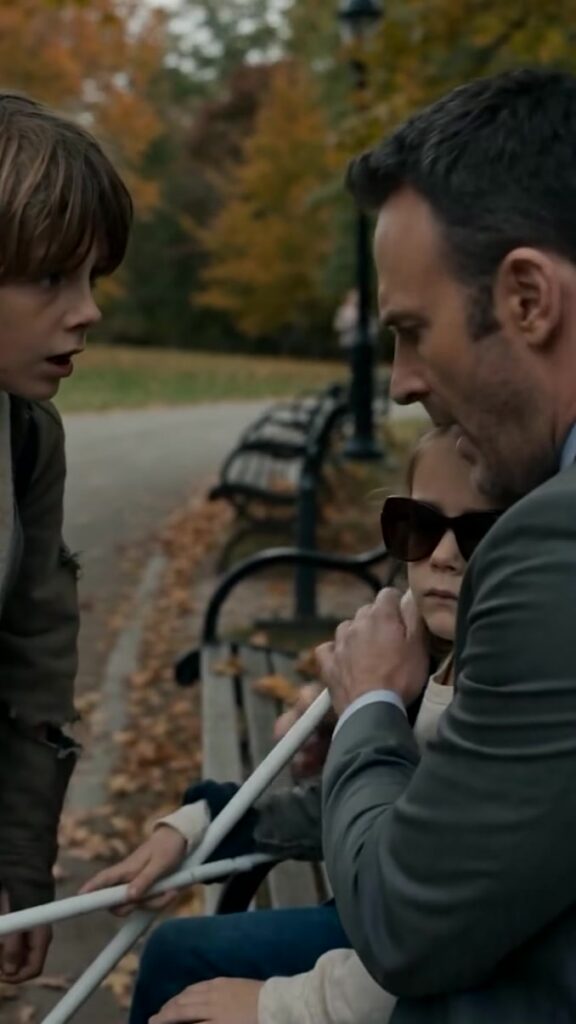
He sat on the oldest bench in the place, its slats polished by years of coats and rain. His gray suit was cut too well for a public park, his tie too straight, his shoes too clean. Beside him, tucked into the crook of his arm, was his daughter, Lila, small in her wool hat and dark sunglasses. A white cane leaned against the bench like a prop that had been onstage too long. Lila’s hands rested in her lap. She breathed evenly, as if the world were a radio turned down low.
Martin’s fingers tightened gently around her shoulder whenever a cyclist passed too close. He told himself he was being a good father—protective, attentive, present. He told himself that the routines were necessary: the glasses, the cane, the careful way he guided her through doors. It kept Lila safe. It made strangers patient. It made his wife—Evelyn—smile that smooth smile that looked like gratitude from a distance.
A jogger moved along the far curve of the path, a woman in a black jacket with a ponytail bouncing behind her. She was a blurred figure against the trees, one more detail in the park’s harmless script. Martin watched her without really seeing her and then looked away, bending closer to Lila. “Do you want to stay a little longer?” he asked softly. “Or would you like hot chocolate?”
Lila didn’t answer right away. She never did. The specialists had explained that her quiet was normal, a side effect of fear and dependence, a child adapting to darkness. Martin waited, patient. He felt her small weight against his ribs and tried not to think about the way silence could spread inside a home like mold.
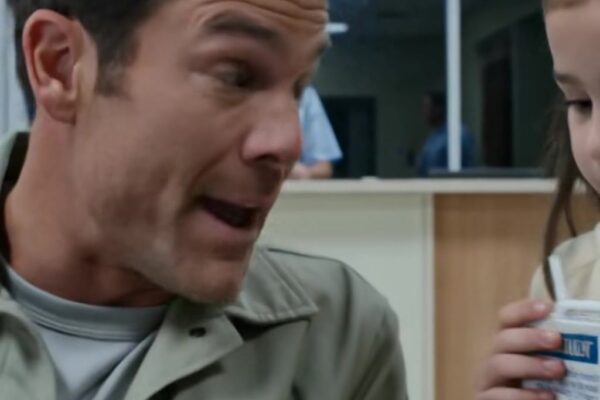
A shadow cut across the bench. Someone grabbed his sleeve—hard enough to pull the expensive fabric taut. Martin jerked, anger spiking so fast it startled him. A boy stood there, maybe thirteen, maybe younger, his limbs thin under oversized, torn clothes. His backpack gaped open, a ragged mouth, and his face was streaked with grime as if he’d washed it in puddles. His eyes were the worst part: wide, bright, and panicked with the kind of urgency adults pretended not to recognize.
“Hey!” Martin snapped, yanking his arm back. “Don’t touch—”
The boy didn’t release him. He leaned in, close enough that Martin could smell sour sweat and cold air trapped in fabric. “Your daughter isn’t blind,” the boy said, words spilling out like he’d been holding them between his teeth for days.
Martin went still. For a heartbeat he only heard the dry rasp of leaves tumbling across the pavement. Then irritation flared—an instinct to protect his child from cruelty. “What did you just say?”
The boy’s grip tightened until his knuckles went pale. “I saw her look,” he insisted. “Just now—she looked.”
As if to betray Martin at the exact moment, a leaf detached itself above them and drifted down in an aimless spiral. Lila’s head tilted, small and smooth, following its descent. Not dramatically—just enough to be unmistakable. Then her cane began to slide, the tip whispering against wood, and her hand shot out to catch it before it fell. A practiced, precise movement. Too fast for someone who lived in darkness.
All the color drained from Martin’s face. His arm tightened around Lila as if pressure could force the truth back into place. Lila’s lips parted, a tiny sound caught there, and then she returned to stillness—too late. Martin stared at her glasses, at the calm set of her mouth, at the cane she held as though it belonged to her role.
“How do you know?” Martin heard himself ask, though his voice didn’t sound like it belonged to him. It sounded like someone else’s, someone walking into a room he’d been warned not to enter.
The boy swallowed, eyes darting to the jogging woman in the distance. She was closer now, her shoes tapping a steady rhythm, her ponytail swinging like a metronome. Still just background—until the boy pointed at her with a trembling finger. “I sleep near your house,” he said. “Behind the garage. There’s a gap in the fence. I didn’t mean to— I just needed somewhere dry. I hear things.”
Martin’s heart began to pound in his ears. “What things?”
The boy’s voice cracked, as though the next words were sharp enough to cut his tongue. “Your wife,” he whispered. “She puts something in her food.”
Martin’s hand loosened for one stunned second. His mind tried to reject the sentence the way the body rejects poison—violent, automatic. Evelyn? His wife who organized fundraisers and spoke in careful tones at school meetings? Who kissed Lila’s forehead every night and cried at doctor appointments? The idea was obscene.
But another memory forced its way in: the way Evelyn insisted on making Lila’s breakfast herself, even when Martin offered. The way she kept the vitamins in a locked drawer “so Lila wouldn’t choke.” The way Lila’s sight had “failed” so gradually that no single moment could be blamed. The specialists. The tests that never landed with certainty. The diagnosis that always carried a question mark in its polite language.
“Why are you telling me this?” Martin demanded, and hated the desperation in it. “What do you want?”
The boy shook his head quickly. “Nothing. I just—” His eyes flicked to Lila, and something like guilt pinched his dirty features. “She talks sometimes when she thinks nobody can hear. Not much. Just… little things. She said she misses colors. She said she pretends so Mommy won’t get mad. I didn’t know what that meant until I saw her look.”
Lila’s fingers tightened around her cane. Her chin angled toward the path, toward the approaching jogger, as if she could feel the woman’s nearness like heat through glass. Martin followed her motion, and for the first time the jogger’s shape sharpened into recognition. Evelyn’s stride. Evelyn’s posture. Evelyn’s steady pace, the kind that suggested control, a life managed in measured increments.
Evelyn lifted a hand in greeting from twenty yards away. Her smile was bright enough to convince anyone watching that this was an ordinary family scene. Then her gaze dropped to the boy—his torn clothes, his filthy face—and the smile did not fade. It simply changed, becoming thinner, more precise.
Martin’s body moved before his thoughts did. He stood, placing himself between Lila and Evelyn, between Lila and the world. His fingers fumbled for his phone, slick with sweat. He didn’t know who he would call. Police? A doctor? Someone who could translate this moment into actions and consequences. Behind him, the boy took a step back, already retreating, already vanishing the way desperate children learned to do.
“Martin?” Evelyn called, breath barely winded. “Who’s that?”
Martin looked at his wife and felt the park’s quiet shift. It wasn’t peaceful anymore. It was watchful. Every tree seemed to lean in. Every leaf on the path looked like it could hide something sharp. He glanced down at Lila, and for the first time he saw not fragility, but fear—alert, contained, practiced. Lila’s head turned slightly toward Evelyn’s voice, and though the sunglasses hid her eyes, Martin could feel her looking.
“Lila,” he said, voice shaking, “can you see Mommy?”
A pause—long enough for Evelyn’s smile to falter, for something cold to flash behind her eyes. Lila’s small hand slid into Martin’s. Her grip was strong.
And in the quietest voice, so quiet it almost blended with the wind, Lila answered, “Yes.”
It was a single word, but it split the park open like thunder. Evelyn stopped walking. The boy turned and ran. And Martin finally understood that the danger in their lives had never needed to be loud. It had only needed everyone to keep believing the silence.