The street felt colder than it should have, though the air carried no winter bite. The sun was up, the storefront windows were bright with reflections, and the commuters moved in their usual currents. Yet the cold was there anyway—an invisible draft that slid between shoulders and under collars, born not of weather but of indifference.
People walked with their eyes trained on a point just above the horizon: next meeting, next errand, next train. At that height, the city was manageable. Below it, near the gutter where the pavement cracked like old porcelain, was the part they trained themselves not to see.
That was where the boy sat.
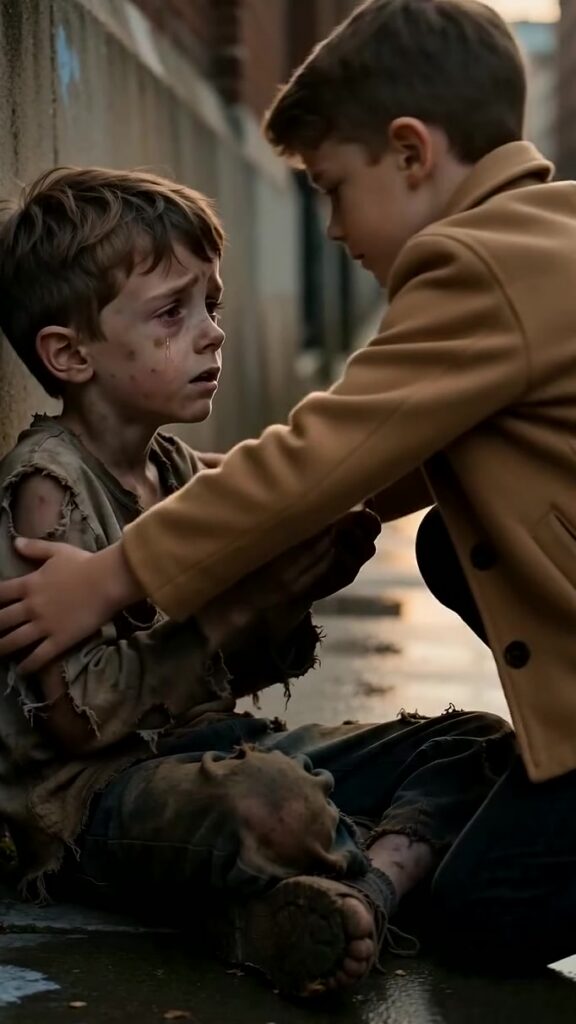
He pressed his back to a gray wall streaked with yesterday’s rain and older stains. His knees were pulled to his chest, arms looped around them like a lock. His jacket used to be blue—maybe. Now it was a tired color, thinned until it offered more memory than protection. One sleeve hung in threads. His shoes had opened at the sides so the toes showed, pink and raw against the street’s grit.
His face was too pale for a child, and his lips trembled as though trying to speak but having forgotten what words could do. Hunger had carved him into something smaller than eight years. When he breathed, it was shallow, careful, the way people breathe when they are trying to make themselves take up less space.
He watched feet pass: polished leather, white sneakers, boots that clicked like impatience. A woman in a red scarf glanced down and then away so quickly it was as if the glance had never happened. A man on the phone stepped around him without breaking his sentence. Someone dropped a coin near the curb by accident, muttered, and didn’t bother to pick it up.
The boy stared at that coin until the gleam blurred. His throat worked. He could not bring himself to crawl for it. Even moving felt like spending the last of something precious.
Then, in the stream of legs and briefcases, there was a pause. Not a stumble. A stop.
A second boy appeared, about the same age, though you could tell at once he belonged to a different story. His coat was camel-colored and clean, belted neatly at his waist. His hair had been combed that morning, his cheeks touched with warmth. In his hands was a piece of fresh bread wrapped in brown paper, the kind that still held the ghost of an oven.
He had been walking with the quick confidence of children who have never had to measure their steps. But now he stood as if he’d stepped into a different temperature. He looked down—really looked. His gaze didn’t slide away. It stayed, steady and troubled, like a hand refusing to let go.
The hungry boy lifted his eyes slowly. At first he looked at the bread, not the other child. The bread was too bright, too real. It seemed like something the street would not allow.
The clean boy’s fingers tightened around the paper. For a heartbeat he hesitated, as though listening for an instruction only adults could hear. Then he peeled back the paper, and the smell rose into the air—warm yeast, salt, something almost sweet. It cut through exhaust and cold stone.
He broke the bread in half. The crack sounded loud in the hollow of the street.
He held one half out.
The boy on the ground stared at it as if it might vanish if he blinked. His hands hovered, unsure of the rules. He’d learned the hard way that gifts were often hooks, that kindness sometimes expected payment in ways children couldn’t afford.
“It’s okay,” the standing boy said, voice quiet but firm, as if he had decided to be brave even if his knees shook. “You can have it.”
Slowly, the hungry boy reached out. His fingers were thin, trembling, nails rimmed with dirt. When his hand closed around the bread, his shoulders sagged in a collapse that was almost a sob.
“Thank you,” he whispered. The sound cracked in the middle, like dry wood. “I was so hungry.”
Tears gathered instantly, not dramatic, not performative—just a sudden overflow from somewhere too full for too long. He didn’t wipe them away. He didn’t have the energy to pretend he wasn’t grateful.
The clean boy didn’t step back. He didn’t look around to check who might be watching. He knelt down right there on the pavement, his trousers meeting the dirty concrete without hesitation. The street’s chill soaked into him, but he didn’t flinch. He leaned forward and wrapped his arms around the other boy as if that were the most natural answer in the world.
For a moment the hungry boy froze, rigid as a stray animal expecting a blow. Then the warmth reached him. It was the warmth of a body fed and safe, of a heartbeat steady with certainty. Something inside him unclenched with a painful, unfamiliar release. He leaned into the embrace and held on, tightly, as if gripping the last rung above a fall.
The city did not stop moving. The stream of passersby continued, glancing, not-glancing. Yet around the two boys, something changed. The cold eased, if only by a degree, as though the street itself had been startled into remembering it was made for people.
It didn’t last.
A door slammed open behind them, hard enough to make the glass rattle. The sound cracked through the air like a whip. Footsteps followed, fast, furious, heels striking the sidewalk with the sharp rhythm of fear.
“No!” a woman’s voice shouted. “Get away from him. Now!”
Her words cut through the small warmth like a knife through cloth. Pedestrians turned their heads. A few stopped. A few pretended not to.
The kneeling boy looked up, confusion widening his eyes. “But Mommy,” he said, still holding the other child as if afraid letting go would undo what he’d done. “He’s cold and hungry.”
The woman—his mother—had rushed out of a boutique with a glossy sign above the door. Her hair was arranged perfectly, as if she had trained it to never break formation. A thin gold bracelet trembled on her wrist as her hand lifted, ready to pull her son back by the collar.
She halted mid-step when her gaze fell fully on the dirty child.
At first she saw only what everyone else saw: a homeless boy, a stain in the city’s picture. Then her eyes traveled across him with a terrible precision—the curve of his brow, the shape of his mouth, the way his left ear tilted slightly as if it had once been tugged too hard.
Her breath caught. The anger on her face dissolved into something else, something raw and unguarded. She stared as though the street had opened under her and she was peering into a place she had sealed shut years ago.
“No,” she breathed, not as a command now but as a refusal of reality. Her hand rose to her mouth, fingertips pressing against her lips as if to keep a scream from escaping.
The boy on the ground watched her with the wary stillness of someone used to being chased away. His grip on the bread tightened. He swallowed, Adam’s apple bobbing sharply in his thin throat. His eyes moved over her face as if searching it for proof.
Recognition flickered there—small at first, like a match struggling in wind. Then it caught.
His voice came out barely above air, but it carried in the sudden hush. “Mom?”
The word fell between them like an object dropped from a great height. People standing nearby held their breath without realizing. The clean boy looked from the woman to the other child, confused, arms still half-around his new friend as if he could hold the world together by sheer will.
The woman’s knees seemed to soften. Her eyes shone, horrified and helpless, as memories pushed up from the deep place she had buried them: a crowded station, a hand slipping from hers, a scream swallowed by the roar of trains and strangers. Years of telling herself there had been nothing more she could do. Years of grieving the boy she had lost.
Now the lost boy sat at her feet, smaller than the last time she’d seen him, but unmistakably hers.
Her lips parted. No sound came. Not yet. The street, cold with apathy only moments ago, held them in its grip as though waiting to see whether warmth could survive the truth.
And in that suspended silence, the hungry child looked up at her with a mixture of fear and hope so sharp it hurt to witness, and he whispered again, as if saying it twice might make it real.
“Mom…?”
The woman’s face crumpled, and for the first time the cold in the street wasn’t from the weather or the strangers—it was from the shock of a life split in two, finally meeting at the seam.