The air above the dirt yard shimmered like a sheet of glass held too close to a flame. Engines ticked as they cooled, and the smell of oil and hot rubber hung over the cinderblock clubhouse. The men lounged in the sliver of shade the awning gave them, their laughter rolling out in rough bursts—tales about the road, about a cop who couldn’t catch a ghost, about a woman who’d thrown a boot at a man’s head and missed by an inch.
At the far end of the yard, the gate squealed open with a sound like a warning. A little boy stumbled through it as if the metal had pushed him out. He wasn’t much more than eight or nine, all elbows and dust, his T-shirt clinging to him with sweat. He ran straight into the middle of the yard, so fast he tripped on his own feet and went down hard, knees hitting the dirt.
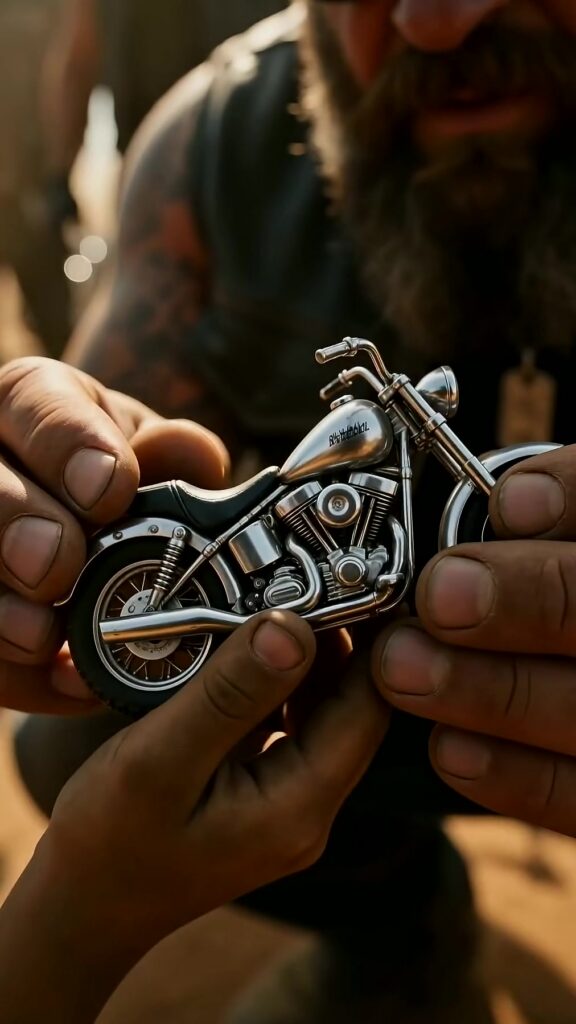
He stayed there, hunched over, crying so violently his body seemed to forget how to breathe. Fine powder leapt up around him and drifted across his shins. Both hands were raised like a plea in church, and in those trembling hands he held something that caught the sun—a tiny motorcycle, silver and bright, shaking with him.
“Please,” the boy choked out, the word breaking. “Please buy it.”
The laughter evaporated as if someone had snapped off a radio. Boots shifted. A few men straightened, and the yard seemed to get larger and emptier. The biggest of them, a broad-shouldered man with a beard that looked like it had been carved from wire, stepped forward. His name was Mason, and his face had the stubborn set of a man who’d spent years refusing to show pain.
He walked until his shadow fell over the boy. The boy didn’t flinch, though his tears kept coming, streaking clean lines through the grime on his cheeks. Mason’s boots pressed small half-moons into the dirt as he stopped.
“What’ve you got there, kid?” Mason asked. His voice was low, not soft, but not cruel either.
The boy clutched the miniature bike tighter, as if it could be stolen by the air. For a second his fingers locked around it like a trap. Then his shoulders hitched and he managed to breathe in.
“My dad made it,” he said. The words came out raw, scraped from somewhere deep.
Mason reached out a hand. The boy’s eyes darted to his face—searching for a threat, for a trick, for the kind of smile that meant trouble. He didn’t find it. Still, his grip stayed fixed until Mason’s fingers hovered inches away, waiting.
“Let me see,” Mason said.
The boy hesitated, then slowly lowered his hands and placed the tiny motorcycle into Mason’s palm as if it were glass and they were both standing on thin ice.
It was heavier than it looked. Mason felt it immediately—the weight of metal shaped by patience, not by a machine stamping out pieces. The bike was detailed down to the chain links, the curve of the exhaust, the fine ridges on the tires. Whoever made it had known motorcycles the way a musician knows a chord without thinking.
At first Mason’s expression didn’t move. Then the sun caught an etched mark near the frame, so small it could’ve been a scratch to anyone else. Mason’s eyes narrowed, and something in his jaw went rigid. The world around him seemed to lose sound.
“Turn around,” he murmured, more to himself than the boy. He crouched, turning the miniature between thick fingers. Near the underside, barely visible unless you knew where to look, was a second mark: a small emblem like a split wheel wrapped in thorns, and beneath it two letters burned into the metal with a tool that left a particular kind of scar.
The men behind Mason had stopped shifting. One of them—leaner, with a sun-bleached ponytail—took a step closer, squinting. “That can’t be—” he started.
Mason held up a hand without looking back. The ponytail man shut his mouth.
Mason looked at the boy as if the boy had suddenly become a message carried by the wind. “Why are you selling it?” he asked. The question came out quieter than the engines cooling in the shade.
The boy’s chin quivered. He tried to answer, but a sob swallowed the first attempt. He dragged in air, sharp and uneven, like a swimmer breaking the surface.
“My dad… he won’t wake up,” the boy said. “He’s on the couch and Mom keeps shaking him and she’s yelling at the phone and my little sister won’t stop screaming.” He wiped his nose with the back of his hand, smearing dirt across his face. “We don’t have… we don’t have money. Mom said we can’t go in the ambulance if we don’t—” He stopped, confused by adult words he’d only half-understood.
Mason’s throat bobbed once. He stared at the tiny bike again, at the emblem, at the letters, and a memory hit him hard enough to make the yard tilt: a garage lit by a single hanging bulb, a man with grease on his knuckles and laughter in his eyes, saying, If you ever need me, you know where to find me.
Mason swallowed. “What’s your dad’s name?” he asked.
“Eli,” the boy whispered. “Eli Ward. He said… he said you’d know.” The boy pointed at the miniature bike, then at Mason, the gesture trembling. “He said if something happened, I should bring the little one. He said you’d understand the mark.”
Mason’s face tightened, not with anger, but with something more dangerous—regret that had been waiting a long time to be invited out. “Eli,” he repeated, and the name sounded like a bolt being loosened.
He stood up too fast. “Hawk!” he barked over his shoulder, and the ponytail man snapped to attention. “Keys. Now. And call it in—tell dispatch to send an ambulance to—” Mason looked down at the boy. “Where do you live?”
The boy blinked hard, startled by sudden motion, by the way men sprang into purpose. “The blue house by the water tower,” he said. “It has the cracked swing set.”
Mason nodded once. “That’s enough.” He turned to the others. “No one rides out slow. You hear me?”
Boots pounded. A chair scraped. Someone cursed as they fumbled for a phone. In seconds, the yard filled with movement instead of laughter. Mason crouched again, bringing his face level with the boy’s. In the harsh light, the boy’s lashes were clumped with tears, his eyes red-rimmed but steady, like he’d run out of panic and only purpose was left.
“You did right coming here,” Mason said. He looked at the miniature motorcycle in his hand, then placed it gently back into the boy’s trembling palms. “Hold on to it. It’s not for sale.”
The boy stared down at it, confused. “But we need—”
“No,” Mason cut in, and the word had the weight of a promise. “Your dad made that for a reason. It’s yours. And your dad…” Mason’s voice caught, just for a breath. “Your dad isn’t alone.”
The boy’s lips parted. “Are you… are you going to help?”
Mason stood and held out a hand big enough to swallow the boy’s. The boy took it, his small fingers disappearing in Mason’s callused grip. Mason squeezed once—not hard, just firm enough to say I’ve got you.
Engines roared awake, sudden thunder in the heat. Mason guided the boy toward a black pickup parked beside a line of bikes. As they moved, the other men fell in around them, not laughing now, not joking. Their faces were set in a way that made them look like what they truly were when the road got dangerous: a pack that didn’t leave their own behind.
As the convoy tore out through the squealing gate and the sun hammered down on their backs, Mason glanced at the child beside him and then at the tiny silver motorcycle clutched to the boy’s chest. The emblem flashed once in the light, a thorned wheel turning without moving.
Some debts could be avoided for years. Some could be buried under miles and noise. But the past had a way of finding the one thing you could never ignore—small hands holding a piece of metal that carried a man’s last instruction.
“Hang on,” Mason said, more prayer than command, as the blue house by the water tower came into view and the day changed shape around them.