He told himself it was nothing—just a habit he’d kept since his own lean years. Every Thursday, after the last table cleared and the kitchen’s heat faded into the tile, Daniel Mercer asked the chef to pack a small extra portion: rice, chicken, something warm that wouldn’t cost much. It was a quiet offering, a way to balance the city’s bright windows against the shadows that pooled beneath them.
That night the air carried a wet cold, the kind that made people walk faster, collars raised, eyes down. Daniel stepped outside the restaurant with the white takeout box tucked under his arm, ready to pass it to whoever was brave—or desperate—enough to linger near the doorway. He saw her before she saw him: a slight girl in a gray dress a size too big, sleeves swallowing her wrists, hem brushing cracked shoes. She stood in the halo of the restaurant’s sign as if it were the only warmth in the district.
“Are you hungry?” Daniel asked, keeping his voice gentle. He’d learned not to sound surprised at need. Need hated being stared at.
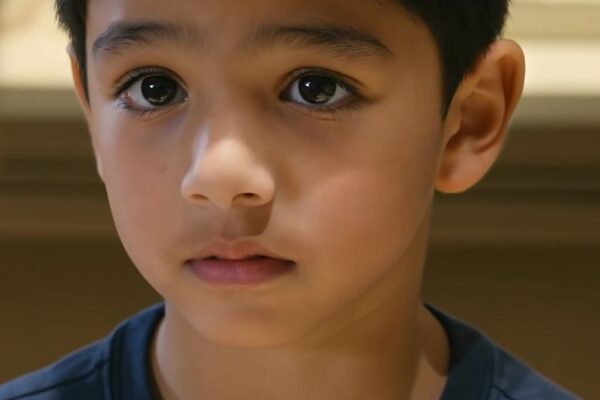
The girl looked up. Her eyes were too steady for someone so small, too practiced. Then her face softened into a smile that made his chest tighten. “Yes, sir,” she whispered.
Daniel held out the box. She took it with both hands, careful, reverent, as if it might crumble if she breathed too hard. “Thank you,” she said, and the words landed heavy with gratitude. He nodded, offered a small smile, and waited for the familiar easing in his ribcage—the sense that he’d done something correct in a city that rarely rewarded correctness.
But she didn’t sit on the curb. She didn’t lift the lid to inhale the steam. She didn’t even glance down as if to confirm it was real. She turned on her heel and ran.
Fast.
Not a stagger, not the sluggish hurry of an empty stomach. It was the quick, clean sprint of someone who’d learned to outrun disappointment.
Daniel stood frozen in the restaurant’s glow while the street swallowed her. Somewhere behind him, laughter rose from a table inside—forks clinking, glasses chiming. He should have gone back in. He should have shrugged and called it a good deed completed. Instead, a strange unease pushed him forward, as if something unseen had tugged a thread stitched into his coat.
He followed.
She cut through a side street where the cobblestones were uneven and slick. She darted around puddles like she knew every dip in the ground. Daniel kept his distance, using lamppost shadows and parked cars as cover, ashamed of his own stalking but unable to stop. The neighborhood changed by degrees—fewer signs, fewer storefront lights, more shuttered doors and boarded windows. The restaurant’s music faded behind him until all he heard was the soft slap of her shoes and the restless sound of his own breath.
She slipped down a narrow alley that smelled of damp brick and old cooking oil. At the end, she paused at a door so worn it looked like part of the wall—paint blistered, frame sagging. Daniel slowed, heartbeat thudding. The girl knocked twice, then once, then pushed the door inward with her shoulder, disappearing into the darkness.
Daniel stopped just short of the threshold. He didn’t mean to look. He only meant to make sure she wasn’t being chased, or tricked, or led somewhere worse than hunger. But the door didn’t close all the way, and the slice of interior light cut across his face like an accusation.
Inside, a room the size of a storage closet held more bodies than it should have. Children—four, maybe five—sat close together on the floor, their knees like sharp angles under thin clothing. Their faces turned toward the girl as if she were the sun. A woman lay propped against the far wall on a mattress flattened by time, her cheeks hollow, her hair tied back in a fraying scarf. Someone had stacked cans near her like a barricade against reality.
“Lina,” one of the smaller boys breathed, and the name filled the room with relief.
The girl—Lina—lifted the takeout box as if displaying treasure. The children leaned in, eyes bright. Daniel watched her fingers work the lid open. Steam curled up, briefly turning the air soft. And then, instead of eating, she tipped the rice into a dented pan and began dividing it with a spoon, scraping the corners so not a grain would be wasted. She made the portion look larger by spreading it thin, by arranging it as though shape could replace volume.
“Did you get enough?” a child asked, voice trembling with hope.
“Of course,” Lina said, smiling too widely. “I ate at school.”
Daniel felt something in him go rigid. That line—too neat, too rehearsed—didn’t belong to a child who’d just sprinted through the cold clutching a meal. Lina kept her smile fixed as she slid the first portion toward the woman on the mattress.
“You eat first, Mama,” Lina said, still bright, still light. “I already had mine.”
The woman’s eyes shimmered in the dimness. She reached for the food with hands that shook. Her gaze moved over Lina’s face—too pale, too carefully composed—and she swallowed hard. When she spoke, her voice was as thin as paper and somehow sharper than any shout.
“You told me that yesterday,” she whispered.
Daniel’s stomach turned. The sentence landed like a door slamming in his mind. Yesterday. Not once. Not a lucky exception. A pattern, a system built on a child’s lies to keep smaller mouths from crying.
In the quiet, Lina kept moving, portioning out rice into makeshift bowls. She pushed food into hands that reached for it like prayer. No one touched Lina’s share. She didn’t assign herself one.
Daniel stepped back into the alley, the cold suddenly vicious. He stared at his own hands, remembering how easy it had been to offer a single box and call it kindness. How neatly he’d tucked the act into his night, like a receipt in a pocket. The city had taught him to believe that need came in manageable doses—one hungry girl, one small problem he could solve without changing anything else.
From inside the room, he heard a child giggle softly at the first warm bite. Then another sound—Lina’s quiet inhale, as if she were trying to fill her stomach with the smell alone.
Something in Daniel broke open.
He didn’t burst in with grand speeches or dramatic tears. He didn’t want to frighten them, didn’t want to be another adult who arrived with the power to disrupt and then leave. He turned and walked back through the alley, faster than he’d come, mind racing ahead of his feet. The restaurant was closed, but the kitchen lights were still on; the chef would still be cleaning down the counters, cursing grease traps and the hour.
Daniel pushed through the back entrance, startling the cook. “I need more,” he said, breathless. “Whatever we have. Bread. Soup. Anything that can stretch.”
The chef frowned, about to argue, then saw Daniel’s face and stopped. “What happened?”
“It wasn’t one,” Daniel said, and the words tasted like shame. “It was never one.”
He drove home afterward with the trunk heavy with food and blankets he’d torn from his own linen closet. At a red light, he called his sister—an attorney who handled cases no one wanted. He called an old friend from university who worked at a clinic. He called until his phone grew hot in his palm, until the night felt less like a wall and more like a door he might force open.
When he returned to the peeling doorway, he didn’t hover in the shadows. He knocked—twice, then once—copying the girl’s signal with the care of someone trying to speak a language he should have learned years ago. The room fell silent. Faces turned toward him—wide-eyed, wary, ready for disappointment.
Daniel held up the bags, the blankets. He lowered himself to their level in the doorway so he wouldn’t loom. “My name is Daniel,” he said softly. “I thought I was helping one person tonight. I was wrong. I’m here to help properly, if you’ll let me.”
Lina stood between him and the others like a tiny shield, chin lifted. For the first time, her smile was gone, replaced by something older than her years: suspicion, fear, responsibility. Her hands were empty now. Her stomach, Daniel realized, probably was too.
“You’ll leave,” Lina said, voice barely audible. “They all leave.”
Daniel looked past her at the woman on the mattress, at the children clutching their bowls as if someone might take them away. He felt the weight of every night he’d walked past suffering because it wasn’t convenient to see.
“I can’t promise the city will change overnight,” he said. “But I can promise I won’t pretend you’re invisible again.”
For a moment, no one moved. Then the woman’s shoulders sagged as if she’d been holding up the whole room by will alone. Lina’s lips trembled, and she glanced back at the children—counting, always counting.
Daniel set the first bag down gently, like placing something sacred on the floor. “May I come in?” he asked.
Lina didn’t answer with words. She stepped aside—just enough space for him to cross the threshold—still watching him with the fierce eyes of a child who had learned how to survive by doubting every promise.
Daniel entered, and the door creaked shut behind him, sealing away the restaurant lights, sealing in the truth. It was too late to call it a single act of kindness. This was something else now—something that demanded a cost, demanded time, demanded that he keep walking back into the dark until it didn’t belong only to them.
He had come with one meal. He stayed because he’d found a whole hunger.