The orchestra had been hired to make the night feel inevitable. Violins stitched silk into air. Brass polished the laughter. Even the chandeliers seemed to hum in time, their crystals trembling softly above the ballroom like frozen rain. The Halston Foundation’s gala was meant to be a statement—proof that Julian Halston could turn money into mercy without losing an ounce of power.
Julian stood at the center of it all, a man tailored into legend. He lifted a glass when donors approached, accepted praise like a king accepts tribute, and smiled as though the world owed him nothing and he owed it even less. Beside him sat Celeste—his wife—perfectly composed, eyes bright as cut stone. She wore her diamonds with the discipline of a soldier. If she felt anything beyond the surface of the night, she kept it hidden behind practiced grace.
The orchestra slid into another waltz, and the dance floor filled with bodies turning in obedient circles. Julian watched them the way one watches a clock: pleased with the order, comforted by the predictability. A photographer called his name. He turned, offered the correct angle of his jaw, and returned to the table where an auction catalog lay open like scripture.
That was when the music faltered. Not a dramatic stop, not yet—just a thin hesitation, a smear of bow against string as if someone had lost their place. A few dancers laughed, thinking it charming. A couple stumbled, then recovered. The conductor frowned, lifted his baton to correct whatever had gone wrong, and found his arm refusing to move. It hovered midair, trembling, as though the air had thickened.
The violins quieted. One by one, instruments died out until only a single cello remained, dragging a note so long it seemed like it might tear. Then even that disappeared. Silence spread, uninvited, across the ballroom.
At first no one understood it as a warning. People looked toward the stage, amused, impatient. Some clapped, thinking it an intermission. Julian, irritated, leaned toward the event coordinator. “What is this?” he murmured. The coordinator’s face had gone pale. Security at the doors shifted, hands at their earpieces, scanning the room.
And then the crowd parted as if a current had pushed through it.
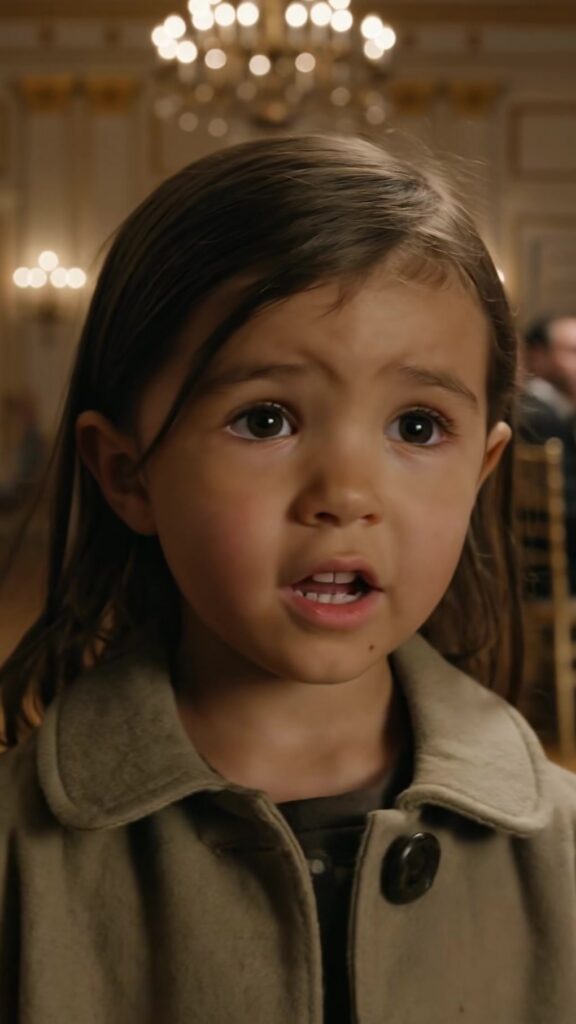
A little girl walked into the ballroom. No one saw which door had admitted her. She was small enough that the hem of her dress brushed the tops of her shoes, simple black leather that looked too practical for a night like this. Her hair was dark and cut straight, the kind of haircut a parent gives when they don’t have time for salons. She did not glance at the chandeliers, the glittering gowns, the guards. She didn’t seem dazzled or afraid.
She moved with the certainty of someone following a line only she could see.
Julian watched her advance, anger rising because the night had been engineered to keep surprises out. A child, unattended, walking straight toward him through donors who instinctively stepped aside—what was this? A stunt? A plea arranged by some rival? He started to rise, to summon security, when he realized she was not wandering. She was coming directly to his table.
She stopped in front of him and said nothing.
Up close, she smelled faintly of rain and old paper. Her eyes were too steady for her age. Julian waited for the script to begin, for tears or shouting or a rehearsed line. None came.
“What do you want?” he asked, forcing a calm that didn’t reach his hands.
The girl raised her arm, slowly, as if lifting something fragile into the light.
In her palm lay a locket on a thin chain. Simple brass, tarnished at the edges, etched with a pattern that might once have been a flower. It looked like a thing from a drawer, not from a jeweler. It looked like a thing no one would notice—except Julian did.
His face changed in a way his donors had never seen. The effortless confidence slipped, as though a hinge inside him had broken.
His glass slid from his fingers. It struck the table, tipped, and spilled champagne across the linen like pale blood. The sound was small, but in the silence it rang. Heads turned. Conversations froze. Someone whispered Julian’s name, not as praise this time but as a question.
Julian stared at the locket as if it had teeth.
“No,” he breathed. The word came out rough. “This isn’t possible.”
The girl didn’t flinch. She didn’t blink much at all. She simply held the locket steady, offering it the way a child offers proof.
Then her gaze shifted past him, to Celeste.
Celeste had been watching with an expression that was almost boredom, as though this were merely another interruption to manage. But the moment the girl looked at her, the woman’s composure cracked. Not dramatically—Celeste was not built for drama—but in a precise, terrifying way. The corners of her mouth twitched. Her eyes widened a fraction, and in that fraction lived a lifetime of careful lies.
The room went cold. Not in temperature, but in sensation, as if every person had suddenly realized they were standing on thin ice.
Julian’s voice dropped. “Where did you get that?”
The girl finally spoke, and her voice was quiet enough that people leaned in without knowing they had moved. “It was in my mother’s box,” she said. “With letters. She said if I ever found you, I should give it back.”
Julian’s throat worked. “Your mother’s name.”
“Marian,” the girl said. “Marian Vale.”
A ripple passed through the crowd. The name meant nothing to most of them. To Julian, it landed like a body falling from a height. His hands tightened on the edge of the table until his knuckles whitened. He remembered Marian as a blur from before the foundation, before the gala, before the years were smoothed into headlines: a woman with ink-stained fingers who typed in a back office and looked at him as though she could see the boy he buried under ambition.
He remembered the night he’d made a mistake and called it loneliness. He remembered the envelope she’d tried to give him months later, the one he had refused to open because he’d already decided what his life would be. He remembered Celeste standing in his doorway, watching with a smile that never warmed.
Julian forced himself to breathe. “How old are you?”
“Eight,” the girl said.
Celeste’s fingers tightened around her napkin, twisting fabric into a rope. “Julian,” she said softly, warning threaded through the elegance. “This is not the place.”
Julian didn’t look at her. His eyes stayed on the child. “What is your name?”
“Elara,” the girl replied. “My mother said you liked stars.”
Julian’s mouth opened, closed. He reached for the locket with shaking fingers. The girl didn’t pull away. The chain slid into his hand like something alive.
He flipped it open. Inside were two photographs, worn at the corners: Marian, younger, smiling with exhaustion; and a newborn wrapped in a hospital blanket, eyes scrunched shut. Tucked behind the photos was a folded slip of paper. Julian unfolded it with a care he hadn’t shown anything in years.
The handwriting was Marian’s—slanted, precise, unmistakable. Not a plea. Not an accusation. A record.
“Julian,” he read silently, each word tightening around his ribs. “I won’t ask you for anything. I won’t ruin you. I know what you chose. But she should know where she came from. If you’re a good man, even once, you’ll look at her and tell the truth.”
His vision blurred. He swallowed hard, lifting his head. The ballroom watched him now, hungry and horrified. The orchestra members sat frozen with their instruments lowered, as if afraid that music might restart time and wipe the moment away.
Julian turned to Celeste at last.
She met his gaze with the coolness that had carried her through boardrooms and scandals and quiet cruelties. But beneath it was a panic she couldn’t polish. “This is absurd,” she whispered. “She could be anyone. Someone’s trying to embarrass us.”
The girl looked at Celeste, unblinking. “You visited my mother,” Elara said, voice still calm. “You told her to stop writing. You said you had people who could make her disappear.”
A collective inhale swept the room. A fork clinked as someone’s hand shook.
Celeste’s cheeks drained of color. For the first time, she looked like a person rather than an image. “That’s a lie,” she said, but the words fell without conviction, as if even she didn’t believe they belonged to her anymore.
Julian felt something inside him—something old, something buried under years of strategic kindness—rise like fire. He thought of Marian’s silence in the letters he never opened. He thought of the way Celeste had always insisted he keep his life clean, free of loose ends, free of inconvenient human beings.
“Where is Marian?” he asked the girl, dread pushing against every syllable.
Elara’s chin lifted slightly, and for a heartbeat she looked impossibly older than eight. “She’s gone,” she said. “She got sick. She said it wasn’t your fault. She said the only thing worse than being forgotten is being remembered as a secret.”
Julian closed the locket and held it to his chest as though it could keep his heart from splitting. The silence in the ballroom was absolute. He could feel the weight of every witness, every camera poised to turn tragedy into tomorrow’s gossip.
He stood, slowly, and pushed back his chair. “Clear the room,” he told his head of security, voice steady in a way he did not feel. “Now.”
Celeste started to rise too, but Julian lifted a hand. “Not you,” he said, and his tone finally carried the steel everyone in the city knew. “Stay.”
The guests hesitated, then began to move, murmuring like a retreating tide. The doors opened. Cold night air rushed in from the corridor, carrying the scent of rain. The orchestra remained seated, their music trapped behind their lips.
When the last donor was gone, Julian looked down at Elara. “You came here alone?”
She shook her head once, almost imperceptibly. “Someone brought me,” she said. “A man with kind eyes. He said you would listen if the music stopped.”
Julian’s gaze flicked to the stage. The conductor sat rigid, face slick with sweat, as if waking from a dream. He stared back, bewildered, hands still hovering near his baton.
Julian understood then that the night had not been interrupted by accident. It had been arranged—not by a rival, not by a journalist—but by the past itself, finding a way through doors that were supposed to remain locked.
He knelt in front of the girl, the expensive floor cold against his knee. “I’m listening,” he said, and his voice broke on the last word.
Elara held his gaze. In the empty ballroom, with the chandeliers humming faintly and Celeste frozen like a statue behind him, the little girl waited for the man who had everything to discover what it cost to keep it.
Outside, the rain began to fall harder, as if the world had decided it could no longer pretend the night was only a celebration.