The riverside park looked unreal in the late afternoon light. Not just “pretty,” but the kind of unreal that made you wonder if your eyes were doing you a favor. Sunlight poured through the trees like honey. The river caught it and threw it back in ripples, as if it had a secret. Even the benches looked like they’d been polished for a movie scene.
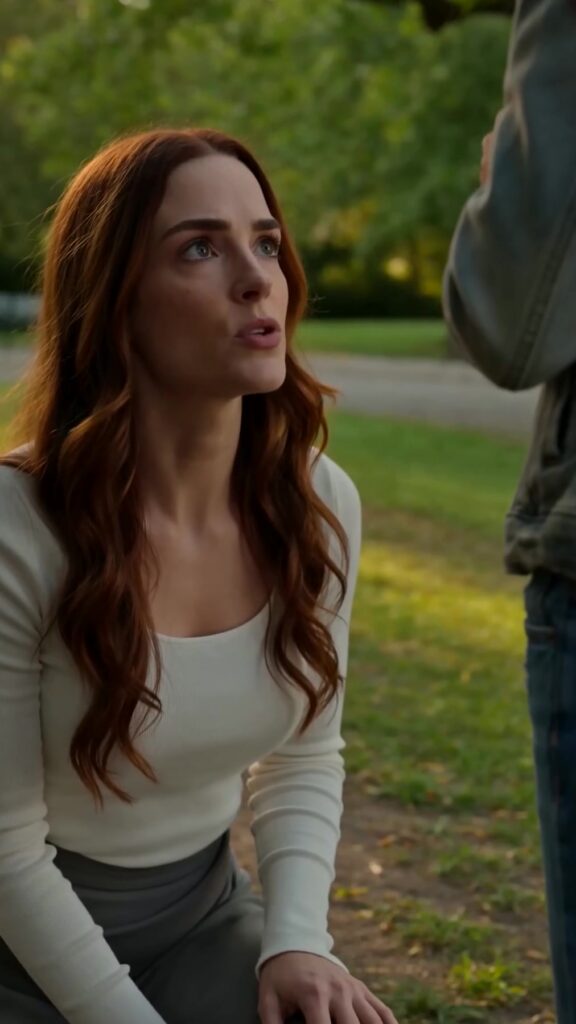
Lena had come there for the easiest kind of peace: the kind you can buy with a paper cup of iced coffee and a walk that doesn’t require talking to anyone. She was still in her work clothes—black slacks, white blouse, hair pulled back in a tired clip—because she’d left the office the second her manager said, “Great job today,” in that tone that meant there would be more work tomorrow.
She was halfway down the path when she noticed the girl. Small, maybe seven or eight, sitting on the edge of a stone planter with her knees pulled in tight. She was holding a hotdog in both hands like it was a fragile object, like if she loosened even one finger it might vanish. The bun had gone a little squished, and ketchup had bled into the bread. Her hair was neatly brushed, which somehow made everything worse.
People walked past. They did the thing adults do: a glance, a flicker of concern, and then their eyes slid away as if looking too hard might trap them into responsibility.
Lena stopped. She didn’t have a plan. She just… stopped.
“Hey,” Lena said softly, like she was approaching a skittish animal. “Is that any good?”
The girl stared at her for a second and then at the hotdog, as if it might answer for her. She gave a tiny shrug. Her lower lip trembled, then steadied, like she’d practiced not crying.
Lena crouched so she wasn’t towering. “Do you have someone here with you?”
The girl’s eyes darted to the path. The river. The trees. Everywhere but Lena. “I was waiting,” she whispered.
“For who?”
“I don’t know.” The words sounded like they came out of a place that was tired of being asked.
Lena’s chest tightened. She reached into her tote bag, pulled out a napkin and a small water bottle she’d forgotten about, and offered it. The girl took it fast, like she was afraid Lena would change her mind.
Then, in a careful voice that didn’t fit a kid eating a hotdog in a golden park, the girl asked, “Why are you being nice to me?”
Lena hesitated. The honest answer was messy—because she’d seen too many people pretend not to see; because she’d been a kid who learned not to ask for help; because today had been long and she needed one decent thing to happen before she went home.
“Because someone should be,” Lena said instead.
The girl took a small bite. Chewed. Swallowed. Her shoulders gradually stopped shaking as if her body had been holding its breath all day and was finally allowed to exhale. For a moment she looked normal, just a kid with a hotdog and a sad little appetite.
Then Lena saw the bracelet.
It wasn’t the kind of bracelet you pick up at a toy store. It was thin and elegant, a pale metal that caught the sun with a quiet, expensive shimmer. A tiny clasp shaped like a lily. Along the inside edge were tiny stones—real ones, Lena was sure, because they didn’t sparkle like glitter. They glowed like something that had been made to last.
And there was something else: a faint scratch on the clasp, like it had been dragged across concrete and lived to tell the tale.
Lena’s throat went dry. She’d seen that bracelet before. Not in person, but on her phone—on a news alert that had made everyone in the office stop pretending to work for two whole minutes.
MISSING CHILD, the headline had said. Private family. High-profile. Reward offered. Photo blurred just enough to protect the child’s identity, but the bracelet had been visible in one shot, peeking from a sleeve. People had speculated online about everything: kidnapping, runaway, family drama. Lena had scrolled past, thinking, That’s awful, and then gone back to answering emails because the world doesn’t pause for tragedies.
Now the tragedy was chewing a hotdog in front of her.
Lena lowered her voice. “Where did you get that bracelet?”
The girl blinked down at her wrist, genuinely puzzled. “I don’t know. I was told it’s mine.”
“Who told you?” Lena asked, forcing her tone to stay gentle.
The girl’s fingers curled around the bracelet as if she’d only just remembered it existed. “A lady. She smelled like flowers and didn’t blink much.”
A cold line drew itself down Lena’s spine. She glanced around. The park was busy enough to be safe and empty enough to be dangerous. Joggers. A couple arguing near the river. A man feeding ducks stale bread. A group of teenagers taking selfies with the sun behind them like it owed them something.
Before Lena could say another word, footsteps approached fast on the gravel path—sharp, purposeful, out of rhythm with the lazy afternoon. Lena looked up.
A man in a tailored coat was coming toward them. Not a “park guy” coat. A city coat, crisp and clean, like he’d stepped out of a car with tinted windows. His hair was perfect in the way that suggested he didn’t do it himself. His gaze wasn’t scanning the park. It was locked, straight and hard, on the girl’s wrist.
When he got close enough, the sunlight hit his face and did nothing for it. It didn’t soften him. It didn’t make him look warm. His eyes stayed cold, like polished stone.
Lena’s instinct screamed: don’t let him near her.
He slowed, smiling without his eyes. “There you are,” he said, as if he was addressing a puppy that had wandered off. “We’ve been looking everywhere.”
The girl froze mid-chew.
Lena stood up, keeping herself between them. Her heart was suddenly loud. “Do you know her?”
He glanced at Lena like she was a lamppost in his way. “Of course I do.” His eyes flicked back to the bracelet. “That belongs to her.”
“What’s her name?” Lena asked. She surprised herself with how steady her voice sounded, like it belonged to someone braver.
The man’s smile tightened. “Excuse me?”
“Her name,” Lena repeated. “If you know her.”
A beat. Just one beat too long.
The girl’s fingers dug into the hotdog. Her eyes went wide, then down, then wide again, like she was trying to make herself smaller.
“Sweetheart,” the man said, skipping the name entirely. “Come here. You know you’re not supposed to talk to strangers.”
Lena’s mind did a frantic inventory. Phone: in her pocket. Pepper spray: at home, of course, because she’d always meant to buy it. The nearest park ranger booth: maybe by the main entrance, five minutes away. The nearest group of people: teenagers, two benches down, too absorbed in their own reflection to be helpful unless she made them.
She dropped her hand casually into her pocket and wrapped her fingers around her phone. “She was just having something to eat,” Lena said. “I’m going to call her parents.”
The man’s eyes sharpened. “That won’t be necessary.” He took one step closer.
Lena didn’t move back. “Actually, it will.” She lifted her phone slightly, enough for him to see it. “Unless you can tell me her full name and her mother’s name. Right now.”
The golden light suddenly felt like it had gone thin. Like it could tear.
The man exhaled, slow, controlled. “You don’t understand what you’re involving yourself in.”
Behind Lena, the girl whispered, so soft Lena barely heard it. “He’s not supposed to find me.”
Lena’s stomach dropped.
The man’s gaze flicked to the girl, and something ugly passed across his face—impatience, not concern. Lena saw it, clear as day, and it snapped the last thread of doubt inside her.
She raised her voice. Not a scream—just loud enough to cut through the park’s lazy soundtrack. “Hey! Can someone call security?”
The teenagers looked up, annoyed, then curious. The duck-feeder paused mid-crumb toss. The arguing couple stopped arguing for the first time in what sounded like hours.
The man’s smile vanished. “Ma’am,” he said, suddenly polite in a dangerous way, “step aside.”
Lena thumbed her phone open and hit the emergency call shortcut she’d never used before. “No.”
The girl’s small hand grabbed the back of Lena’s blouse, clinging like Lena was a tree in a flood. Lena felt the tug and, weirdly, felt steadier because of it. Like being needed turned fear into fuel.
The phone began to ring. One ring. Two.
The man’s eyes darted, calculating: the growing attention, the distance, the risk. The late afternoon light gleamed on the bracelet again, and Lena realized the bracelet wasn’t just jewelry. It was a tag. A message. A claim.
A voice answered on the line, calm and trained, and Lena said, fast and clear, “I’m at Riverside Park near the stone planters by the south path. There’s a little girl here, and a man is trying to take her. I think she’s the missing child from the news. He’s wearing a dark tailored coat.”
The man took a step back, his expression rearranging itself into something smooth and normal. “This is a misunderstanding,” he said, louder now for the witnesses, as if volume could rewrite reality.
Lena kept the phone to her ear and her eyes on him. The golden park held its breath. Somewhere in the distance, a siren began to rise, faint at first, then louder, threading through the honeyed air like a crack in glass.
The girl behind Lena whispered again, her voice finally breaking. “I didn’t know where else to go.”
Lena didn’t turn around, but she reached back and took the girl’s hand. It was small and clammy and real. “You’re okay,” Lena said, not because she was sure, but because the girl deserved to hear it from someone who meant it.
The man’s jaw tightened. He glanced once more at the bracelet, like he was deciding whether it was worth the trouble. Then he shifted his weight, readying himself to move—either forward, or away.
And the park, glowing and impossible, waited to see which choice he’d make.