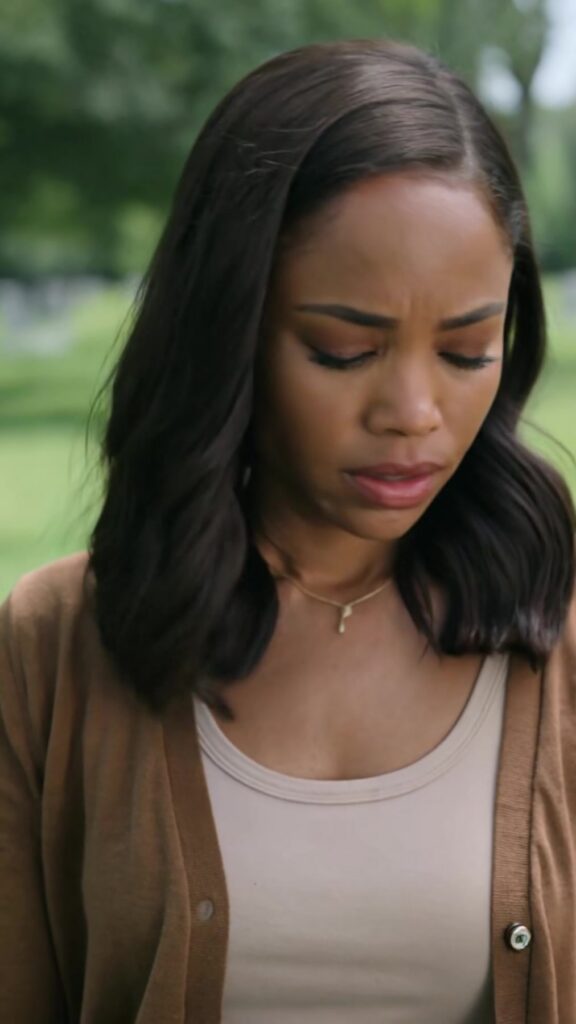
The mother had visited the grave so many times that grief had started to feel rehearsed. Like a play she’d never auditioned for but somehow kept getting cast in anyway: park the car under the same maple tree, carry the same kind of flowers because the florist now recognized her face, follow the same cracked path, and kneel at the same stone with the same practiced sigh. Even her crying had developed timing. A few minutes of swallowing hard, a few minutes of letting the tears happen, then the “brave” exhale that told the world she was doing better.
Today, she wore the blue dress with tiny flowers because it was the one her sister said made her look “alive.” She didn’t feel alive, exactly—more like a person-shaped habit. She set the lilies down carefully beneath the framed photo propped against the headstone. In it, two girls grinned into the sun, cheeks pressed together, hair tangled from running. Everyone always told her to hold on to that version. Remember them happy. Don’t torture yourself with questions.
“Hey, babies,” she murmured, because the words were automatic now. “I brought the flowers you like.” She said it the way you say hello to someone on the phone when you already know they won’t pick up.
Behind her, feet shuffled on the path. A cough. The cemetery was quiet enough that the smallest sounds felt rude. She glanced over her shoulder and saw a woman hovering a few steps away, cardigan too warm for the season, a boy beside her with a toy car clutched in one hand. They’d probably taken a wrong turn on the way to another plot and didn’t know how to pass without intruding.
“Sorry,” the cardigan woman whispered, already halfway into a retreat. “We’ll just—”
The boy wasn’t interested in being subtle. He stepped closer, craning his neck at the framed photo like it was a poster for a movie he recognized. Then he pointed straight at it, arm stiff, finger accusing the air.
“Mom,” he said, loud in a way that made the mother’s skin tighten. “Those girls are in my class.”
It didn’t feel like the world stopped. It felt like it slipped a gear, like her brain tried to keep going but couldn’t catch the next thought. Her hand was still on the lilies. She realized she’d been stroking the petals as if they were hair. She stopped. She forgot how to breathe without permission.
“Honey,” the cardigan woman hissed, mortified, reaching for the boy’s shoulder. Then she looked at the kneeling mother and her expression flipped through embarrassment, worry, and a thin, quick flash of something that almost looked like guilt for existing here at all. “I’m sorry. He—he gets faces stuck in his head. He probably means—”
But the boy kept going, as kids do when they don’t understand they’ve just kicked a hornet’s nest of adult pain. “The one with the braids,” he added, tapping the glass of the frame with his fingertip. “She sits near the window. And the other one—she wears her hair down now. But it’s them.” He squinted, as if being accurate was important. “The quiet one doesn’t smile at school either.”
The kneeling mother’s knees wobbled so hard she had to grab the edge of the stone to stand. Her sadness, the practiced kind, broke apart like cheap paper in rain. What came up instead wasn’t joy. It wasn’t even anger. It was a sharp, hunting kind of hope, the sort that doesn’t care if it gets you hurt as long as it gets you moving.
“Please,” she said, and her voice sounded wrong in her own ears. Dry. Strained. “Please… can I ask him what he meant?”
The cardigan woman blinked, swallowed, and gave a small nod. “Okay. Yes. I mean—he’s a kid. He says things.” She stared at the headstone and then back at the photo as if seeing it for the first time. “But he’s not… he’s not usually wrong about faces.”
The mother crouched to the boy’s level, careful not to loom. She could feel herself trying to control her expression, trying to not scare him, trying to not spill her whole history all over his sneakers. “What’s your name?”
“Owen.” He held up the toy car like it was a badge. “This is Turbo.”
“Owen,” she said, mouth trembling around the syllables. “Where do you go to school?”
“Maple Ridge.”
Her stomach dropped. Maple Ridge was across town. She didn’t know anyone across town. She didn’t have a life across town. She had this cemetery and a couch shaped like her body and a grocery store where the cashier always looked away when she bought tissues and microwave meals.
“And the girls,” she said, forcing the question out one word at a time. “They’re… in your class?”
Owen nodded like this was the easiest thing in the world. “Yeah. The teacher calls them ‘new students’ but they’ve been new for a long time. They sit together. They don’t talk much. The braids one draws a lot. The other one stares at the door like she’s waiting for someone.” He frowned, offended by the memory. “One time I said hi and she looked at me like I stole something.”
The mother’s throat tightened so hard it hurt. The framed photo blurred. She pressed her fingers to the edge of the glass, grounding herself. “What are their names?”
Owen shrugged. “They told us to call them Nora and May. But I think those are pretend names because they never answer fast. Like they have to remember.” He tilted his head, studying the mother’s face now, finally noticing the way it was breaking. “Are you… are you their mom?”
Her laugh came out as a tiny, jagged sound. “I’m—” She almost said yes. She almost said of course. But her daughters’ names had been Lily and Hazel. She had whispered those names into this stone a hundred times. She had written them on birthday cards she never mailed. “I’m… I’m someone who misses two girls very much.”
The cardigan woman cleared her throat, nervous. “Owen, buddy, maybe—”
“No,” the mother said too quickly, then softened it. “Sorry. I’m sorry. I just… can you tell me—do you know where they live? Or who picks them up?”
Owen scrunched his face in thought. “A lady with a shiny car picks them up. Not a mom lady. Like a… business lady. She wears sunglasses even when it’s cloudy.” He pointed vaguely toward the cemetery entrance as if the answer might be parked there. “She says ‘let’s go’ like she’s in a hurry. And the girls get in fast. Like they practice.”
The mother felt her heartbeat in her teeth. Practice. Ritual. Rehearsal. Suddenly every part of her life looked like someone else’s script. The accident report she’d never been allowed to read. The closed casket funeral. The way the officer had kept glancing at her hands like he didn’t want her touching anything. The insurance payout that arrived too neatly. The grief counselor who kept redirecting her whenever she said the word “why.”
“What do they look like now?” she asked Owen, her voice steady only because her body had decided panic was easier if it moved in a straight line. “Besides… besides the hair.”
Owen lifted his hands and gestured the size of them. “Taller than me. The window one has a little mark here.” He tapped his eyebrow. “Like she bumped it. And the other one has a tooth that’s kind of crooked but she tries not to show it.” He paused, then added, almost gently for a kid. “They look… tired.”
The mother’s eyes stung. She pictured Lily’s stubborn eyebrow scar from falling off a bike. Hazel’s slightly crooked tooth she used to hate until the day her sister told her it made her smile look like a secret. The air went thin.
She stood too fast, dizzy. The cemetery spun: clean grass, gray stones, pale sky pretending innocence. She looked at the cardigan woman. “I need you to tell me what you know. Everything. Please.”
“I don’t know anything,” the woman said, but her voice cracked on the last word. She was watching the photo now like it might bite her. “I just… I volunteer at Maple Ridge sometimes. I help in the library. I’ve seen the girls. They don’t have visitors at school. No one comes to conferences for them. And when I asked the office, they said their records were ‘sealed.’” She swallowed. “Schools don’t say that. Not like that.”
The mother’s hands clenched. The lilies lay at the base of the stone, perfect and trembling in the breeze like they were trying to look normal. She stared at the headstone, at the names carved there, at the dates that had anchored her misery. For the first time since the funeral, she didn’t feel like she was speaking to the dead. She felt like she was standing over a lie someone had been maintaining for years because they assumed she’d keep performing her part.
She reached into her purse, fingers shaking, and pulled out her phone. Her thumb hovered over the screen, over numbers she’d deleted and re-saved a dozen times. She didn’t know who to call first—police, school, lawyer, the sister who had begged her to stop digging. She didn’t even know what to say without sounding insane.
Owen tugged at her sleeve. “Are you gonna tell them you found them?” he asked, as if this was a game of hide-and-seek that had gone too far.
She looked down at him, at his open face, at how unafraid he was of the mess he’d just made. Her throat worked around a new sentence, one that didn’t belong to the rehearsed version of her life.
“Yeah,” she said quietly. “I think I am.”
Then she turned away from the grave—away from the tidy sadness she’d been living in—and started walking toward the parking lot like someone who’d finally been handed the next page of the script. Behind her, the photo of the smiling girls caught a sliver of light, and for a second it looked less like a memorial and more like a warning.