The toy store was loud with music, color, and happy voices. It was the kind of place that tried really hard to make you forget time existed—tiny speakers piping out bouncy songs, a plastic train looping around the ceiling, and walls painted in colors that didn’t occur in nature. Kids darted between aisles like pinballs. Parents hovered behind them, half-smiling, half-calculating what “just one thing” would turn into by the register.
Near the back, where the shelves were a little dustier and the floorboards creaked like they were tired of being cheerful, an old man paused with his granddaughter. His coat looked like it had survived several winters it wasn’t supposed to. The girl’s sneakers were scuffed down at the toes, and her sleeves ended an inch above her wrists like she’d grown overnight and nobody had noticed.
But she wasn’t looking at her clothes or the other kids. She was staring at a teddy bear—soft brown, round ears, stitched smile, the kind that looked like it would be patient with secrets. It sat on the middle shelf like it had picked that spot on purpose, right where her hands could reach if she stretched just a bit.
She lifted her fingers toward it and hesitated, like touching it might set off an alarm. Then she whispered, almost like she was asking permission from the bear itself. “Grandpa… if I hold it for a moment, does it count? Like… it’s mine, but only for a second?”
The old man’s face did something complicated—tightened around the eyes, softened around the mouth. He was about to answer when a sharp voice cut across the aisle. “Nope.” A young employee in a bright store vest stepped in fast, scooped the bear off the shelf, and held it like evidence. “You don’t just grab stuff. This isn’t a free petting zoo.”
Everything didn’t go quiet, not exactly—the music kept playing, the train kept circling—but the air changed. A boy froze mid-vroom with a toy truck in his hands. A mom near the doll aisle stopped comparing boxes. Even the cashier, who had been scanning items at the speed of a machine, looked up like someone had switched on a different kind of light.
The little girl jerked her hand back like she’d touched something hot. Her cheeks went red. She scooted closer to her grandfather’s side, and he put an arm around her shoulder, steady and protective. “Hey,” he said to the employee, voice low and calm. “Please don’t scare her.”
The employee didn’t lower his tone. If anything, he raised it, aiming his words like they were meant for the whole store. “Then maybe take her outside before she starts begging for things you can’t pay for.” He pointed toward the front as if he was directing traffic.
The girl’s eyes flooded instantly. She pressed her face into her grandfather’s coat like she could hide inside it. The old man didn’t argue. He just stood there, absorbing the humiliation with the kind of practiced stillness that comes from having had to swallow too many comments in public places.
That’s when a man in a blazer rounded the end of the aisle—store manager, by the way he carried himself, the way the employee’s shoulders tensed the second he appeared. The manager’s mouth opened, probably to deliver a rehearsed speech about “customer experience” and “respect.” Then he stopped like he’d hit an invisible wall.
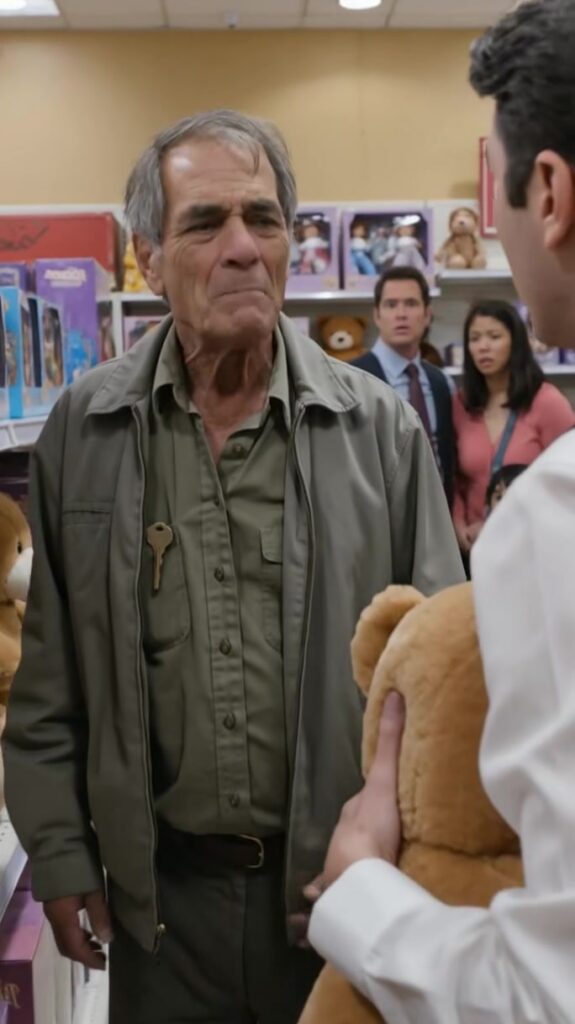
His gaze had dropped to the old man’s pocket. Something metal hung from a short chain clipped inside the coat—an oversized brass key, dulled by time, heavy enough to look like it belonged to another era. The manager stepped closer, ignoring the employee completely. “Where did you get that?” he asked, but not in a bossy way. In a stunned way. “That key… that’s an old store key.”
The employee blinked. “Sir, I—”
“Not you,” the manager said, eyes still locked on the key. He lowered his voice, like he didn’t want the walls to hear. “That key belonged to the first shop that stood here. Before my parents expanded, before the renovations, before the neon sign. We were told those keys disappeared.”
The old man didn’t reach for it right away. He looked at the girl first, brushing his thumb gently across her hair as if reminding her she wasn’t in trouble. Then he covered the key with his rough hand, not hiding it so much as honoring it. “It was given to me,” he said, “by the woman who lost the place. The real owner. Before your family ever put their name on the papers.”
The manager’s face drained of color. “That doesn’t make sense,” he murmured, more to himself than to anyone else. “My father always said the founder’s daughter ran off. That she stole money and disappeared. That the shop had to be rebuilt from scratch because of what she did.”
At that, the little girl lifted her head from the coat, eyes wet but steady. “My mom said Grandpa shouldn’t throw it away,” she whispered, voice shaking but determined. “She said one day it would prove who she really was.”
The manager stared, and in that stare you could see years of family stories rearranging themselves in real time, like a puzzle that had been forced into the wrong picture. He looked at the old man. “Your daughter… she’s the founder’s daughter?”
The old man nodded once. “She was nineteen when they accused her. She didn’t run away. She was pushed out. Threatened. Everyone in town believed what they were told to believe. She left with nothing but this key and her pride. And she raised my granddaughter’s mother to keep going, even when it hurt.” He exhaled slowly. “I’m not here to cause a scene. We just… came to look.”
Behind them, the employee shifted like he wanted the floor to swallow him. The manager didn’t even glance back. He reached into his blazer pocket and pulled out his phone, thumb hovering over the screen. Then he stopped, as if he realized calling someone wouldn’t fix the last five minutes, let alone the last twenty years.
Instead, he crouched so he was eye-level with the girl. His voice got softer. “What’s your name?”
“Mara,” she said, sniffing once, trying hard to be brave.
“Mara,” the manager repeated, like he was memorizing it. He stood and turned to the shelf where the employee had returned the teddy bear—except the bear wasn’t there anymore. A different kid had taken it during the commotion. The manager didn’t seem bothered by that. He walked to a display near the register and picked up a bigger bear, even softer, with a little stitched heart on its chest. He brought it back and set it carefully in Mara’s arms like it was something important, not just merchandise.
“This one’s yours,” he said. “No conditions. No ‘just for a second.’ And I’m going to ask you and your grandpa to come to my office after—because that key and that story shouldn’t be whispered in an aisle.” He glanced toward the employee, finally. “And neither should insults.”
Mara hugged the bear tight, the way you hug something when you’re afraid it might vanish if you breathe wrong. The old man’s eyes shined but he didn’t let the tears fall. He just nodded, the smallest nod, and for the first time since they’d walked into the loud, bright, happy store, he looked like he could stand up straight without bracing for impact.
As they walked toward the front, the music kept playing, the train kept looping, and the store kept being colorful. But the air felt different—like someone had finally opened a window. And the old brass key, swinging lightly from the grandfather’s pocket, didn’t look like a relic anymore. It looked like a door that was finally about to open.