The street was loud. Alive. Full of movement. Horns tangled with snippets of music from a busker’s speaker, the metallic churn of a subway vent, the slap of hurried shoes. Yellow taxis streaked by like impatient punctuation. People cut around one another without looking, each sealed inside a private emergency or a private dream.
Mara liked this part of the city because it asked nothing of you. It didn’t care if you were grieving or guilty, if your hands shook when you tried to pay for coffee, if you’d started jumping at sirens for reasons you wouldn’t explain. The city simply moved. And if you moved with it, you could pretend you were fine.
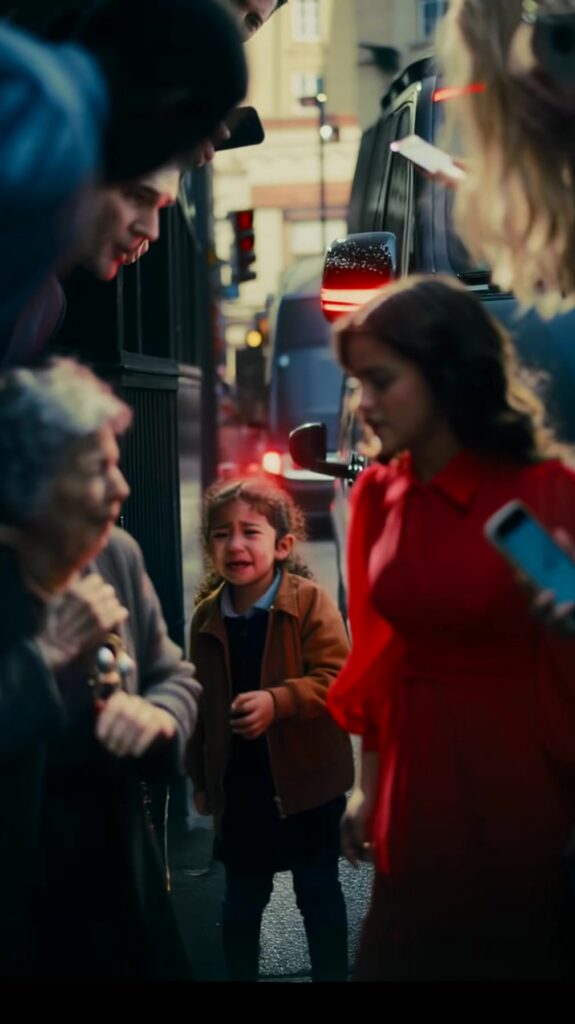
She adjusted the hem of her red dress—too bright for a weekday, too sharp for the mood she kept tightly folded inside her—and tightened her grip on Elsie’s hand. Her daughter’s fingers were small, sticky from a pretzel. Elsie skipped, dragging Mara half a step behind, pointing at everything: a man balancing a tower of boxes, a dog in a sweater, a balloon vendor fighting the wind.
“Slow down,” Mara said, smiling because that was what mothers did, and because smiling was easier than remembering.
They were almost at the crosswalk when a sound slipped through the noise: a thin, trembling melody, sung under someone’s breath. Not loud. Not confident. But unmistakably shaped with care. A lullaby.
Elsie jerked to a stop. “That’s Daddy’s song,” she whispered, as if saying it out loud might break it.
Mara’s stomach tightened, sudden and sharp. She turned and saw an old woman a few steps away, standing near the mouth of an alley, holding out a small wind-up toy—a tin bird on wheels painted sky-blue, its little wings jerking stiffly as it rolled in a circle. The woman’s hair was white and thin, her coat patched at the elbows. Around her neck hung a small charm on a chain, worn so smooth it looked like it had been held a thousand times.
Elsie’s eyes fixed on the toy, and she took one step forward, as if pulled by a string. The old woman’s mouth moved—still humming the lullaby—and her eyes softened at the sight of the child.
Mara lunged between them.
The slap of her palm against the toy cracked through the street like a gunshot. The tin bird skittered and clanged across the pavement, spinning before it toppled onto its side.
“DON’T TOUCH MY DAUGHTER!” Mara’s voice came out bigger than she meant it to, bigger than the moment could hold. It startled even her.
The street changed. A ripple of stillness spread outward, the way water stills around a dropped stone. Footsteps paused. A pair of teenagers froze mid-laugh. Somewhere, a phone camera rose like a reflex. Even the taxi horns seemed to thin and retreat.
The old woman staggered as if struck. Her hands came up, empty, shaking. She looked smaller under the weight of everyone’s attention, her cheeks flushing with quiet humiliation. “I was just trying to—” she began, but her voice dissolved in the tightened air.
Elsie’s face crumpled. She burst into tears, sound bright and sharp. Mara reached for her, prepared for the familiar clinging, the burying of a face against her hip.
But Elsie did not run to her mother.
She stretched her arms toward the old woman, sobbing hard enough to hiccup. “But she sings Daddy’s song,” Elsie cried. “She sings it like Daddy.”
The silence that followed was unnatural, thick as fabric pulled tight.
Mara felt it first in her bones, a cold spreading outward from her ribs. Her grip on Elsie’s wrist loosened without her deciding to let go. For one unguarded second her face betrayed her: confusion, then something like fear, then a scramble toward denial.
“That’s nonsense,” she snapped, but the edges of the words dulled as soon as they left her mouth. She could hear her own heart beating, loud as the traffic had been.
A car door slammed nearby—heavy, expensive. Heads turned. A sleek black sedan had eased up to the curb, and from it stepped a man who looked like he belonged to a different city, one with quieter streets. He wore a dark coat, his posture straight the way soldiers stand even when they’re supposed to be relaxed. His hair was trimmed with careful neglect, and there was a tiredness around his eyes that no money could smooth away.
He had heard everything.
His gaze moved slowly—from the child’s trembling arms, to the old woman in the alley’s mouth, to Mara’s red dress like a warning sign. His expression changed with a speed that made Mara’s breath catch. Color drained from his face as if someone had pulled a plug.
“That song…” he said, not quite to anyone, his voice almost lost under the city’s returning murmur.
The old woman did not move. Her lips trembled as if she’d been holding words back for years and they were finally pressing at the seams.
Mara’s instincts—honed by too many nights of watching the door, too many memories of headlines—kicked hard. She yanked Elsie toward her. “What are you doing?” she demanded, too sharply, to the man, to the old woman, to fate itself. “Let’s go.”
Her fingers closed around Elsie’s arm, but Elsie pulled back with surprising strength. The child’s hand stretched out again, reaching for the old woman as if the distance between them was the only wrong thing in the world.
The man took a step closer. Then another. It was not the stride of a stranger approaching a scene; it was the pull of a tide. His eyes were fixed on the charm at the old woman’s throat. Small. Scratched. Familiar. A little metal locket shaped like a bird, its beak worn blunt, its wings smoothed down by touch.
His hand rose, shaking. “That can’t be,” he whispered, and the words sounded like a prayer and an accusation tangled together.
The old woman lifted her chin. Her gaze found his face and held it, studying as though she were reading a long-forgotten page. Tears gathered in her eyes, catching the light. “You remember it,” she said softly. It wasn’t a question. It was a fact she’d been starving on.
The man’s throat worked. “No,” he said, but it was a weak protest. “That charm was buried with—”
He stopped. The rest of the sentence refused to exist in the open air.
Elsie’s sobs quieted into sniffles. She looked between them, bewildered, her little eyebrows pinched together the way they did when she tried to understand grown-up conversations. “Daddy,” she asked in a small voice that sliced through Mara’s panic, “why is she crying?”
The man flinched at the word. Daddy.
Mara felt her world tilt, the street beneath her suddenly unreliable. She hadn’t meant for Elsie to say it. She hadn’t meant for him to be here. She hadn’t meant for anything to come back.
The man looked at Elsie like he was seeing a ghost that had learned to breathe. His eyes traced her face—her nose, her mouth—and then, with a kind of grief-stricken reverence, he noticed the small crescent-shaped birthmark at her temple. Something in his expression cracked open. A memory surged: smoke and sirens, heat blooming up a staircase, a child’s cry swallowed by roaring flames, his own hands blistered as he pounded on a door that would not give.
“You were supposed to be dead,” he said, and the street around them seemed to fall away, leaving only the three of them and the old woman’s trembling song.
The old woman’s tears finally spilled, tracing clean lines down weathered cheeks. She took a step forward, the charm bouncing against her chest, and her voice shook with the weight of what she carried. “I tried to die,” she said. “I tried so hard.”
Mara’s mouth opened, but no sound came. She could taste metal, as if the past had bitten her. Her fingers tightened on Elsie’s arm again, not to pull her away but to anchor herself. “No,” Mara managed. “You—”
The old woman’s gaze flicked to Mara then, and in it Mara saw recognition—sharp, terrible. “Marianne,” the old woman breathed, as if speaking the name might summon the girl Mara used to be, before she became someone who wore red dresses like armor.
The man’s face turned toward Mara. Understanding flashed there, swift and brutal. Not just surprise. Not just confusion. A dawning horror, as if pieces were sliding into place and the picture they formed was unbearable.
“Mara,” he said, his voice low. “What did you do?”
The city’s noise returned in a rush: honks, chatter, the distant wail of an ambulance. But the circle of people around them held, phones still raised, eyes hungry.
Mara swallowed hard, her throat burning. She could feel the old lie—carefully constructed, rehearsed, repeated—shaking loose like rotted boards underfoot. She looked at the old woman, at the charm, at Elsie’s reaching hand, and she saw the night she’d sworn she would never speak of again.
The fire was not an accident. The goodbye had been staged. The grave had been empty.
And now, in the middle of the loud, living street, with strangers filming and her daughter sobbing, the dead had stepped back into the world.
The old woman took another step closer, her hands out, palms open in surrender. “I didn’t come to take her,” she said, voice breaking. “I came because I heard you moved back. I came because I couldn’t keep the song inside me anymore.” She glanced at Elsie, and her face softened with a love that looked like pain. “He used to sing it to you,” she whispered to the man. “Before you ran into the fire.”
The man’s eyes shut for a moment, as if bracing against impact. When he opened them again, they were fixed on Mara, and there was a terrible steadiness there. “If she’s alive,” he said, nodding toward the old woman, “then everything I believed about that night is wrong.”
Mara’s breath came shallow. The crowd pressed in half a step. Elsie’s hand slipped from Mara’s grasp, tiny fingers reaching the old woman’s sleeve at last, clutching it like a lifeline.
Mara watched her daughter cling to the woman she’d declared a threat, and something in Mara’s chest broke with an audible silence.
She had spent years outrunning the truth, letting the city’s movement blur the edges. But the street had stopped for her now. It had frozen to witness the moment the past refused to stay buried.
“We need to go,” Mara whispered, though she didn’t know who she was speaking to—herself, the child, the man, the dead woman with her father’s charm. Her eyes darted to the black car, the driver waiting like a shadow, to the phones recording, to the faces that would become tomorrow’s gossip.
The man stepped closer until he stood within arm’s reach. His voice dropped to something only she could hear, and it held the weight of all the years he’d been missing. “Tell me the truth,” he said. “Right now. Or I swear I will tear this whole city apart to find it.”
Mara stared at him, at the stranger who still knew the shape of her name. Then she looked at Elsie, who was no longer crying, only listening—wide-eyed, trembling, as if she could sense the story hidden behind every adult breath.
Across the old woman’s necklace, the charm caught the light and flashed like a signal.
Mara’s lips parted. The first word of confession rose in her throat—hot, sharp, unstoppable—
And somewhere behind them, in the crush of onlookers, a voice called out, too loud, too eager: “Hey! Isn’t that—?”
Mara turned, and in that single movement she realized the worst thing wasn’t what she’d done.
It was that the city, loud and alive and full of movement, had finally noticed.
And it was watching.