Rain drove itself against the front windows of Merren & Co. like a fist that refused to tire. Each gust smeared the streetlamps into wavering halos, turning passersby into dark strokes of ink. The city sounded far away behind the glass, as if the storm had wrapped the block in cotton and anger.
Inside the shop, time behaved. Lamps with honey-colored shades warmed the counters. Watches ticked in their velvet nests. Silver rings lay in disciplined rows, glinting patiently beneath white display lights. The air smelled faintly of polishing cloths and old cedar drawers. Gideon Merren liked it this way—quiet, predictable, contained. Routine, he had learned, could be a kind of prayer.
He was closing up early, hands moving by habit: latch the back safe, log the day’s repairs, wipe fingerprints from the top of the front case. The storm had chased away customers hours ago. Only the rain remained, and the steady, familiar ache in his left wrist where an old cut had healed wrong.
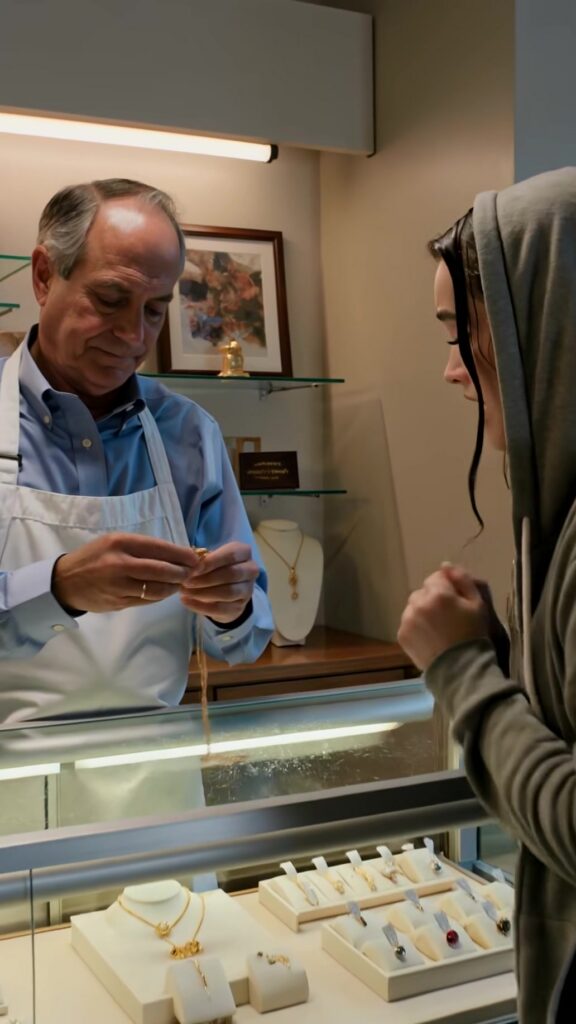
Then the door shuddered under a sudden impact and swung wide, letting in a spear of cold air and the roar of weather. A young woman stumbled over the threshold as if the street had been trying to keep her. Water streamed off her hood and down her jaw. Dark hair clung to her cheeks and neck, and her breath came in sharp, ragged pulls. She looked like she’d been running for longer than the block outside could account for.
Her hands were fisted around a necklace, knuckles pale, the chain looping through her fingers like something alive. Even in the gloom at the doorway, Gideon caught a flash of gold.
“I—” She swallowed, eyes scanning the shop as if expecting it to change shapes. “How much would you give me for this?”
Gideon had learned not to meet desperation with softness. Softness made promises; promises were debts. He gestured toward the counter, and she came forward, leaving puddled footprints on the worn rug. When she laid the necklace down, her hands did not release it immediately. They hovered a moment longer, trembling, as if letting go might undo her.
Gideon picked it up with the careful distance of a man who’d handled everything from heirlooms to lies. The chain was old but sound. The clasp was a style you didn’t see often now. The gold had a muted gleam that spoke of years, not shine.
“Fifty,” he said, already reaching for the scale, already thinking of the ledger. “That’s what it’s worth to me.”
“Okay.” The word leapt out of her too fast, without the usual protest. “Okay. Deal.”
That was what snagged him—not the necklace, not the storm, not even the way her gaze kept flicking to the window as if counting seconds. People argued. People pleaded. People tried to sweeten the bargain with stories. She accepted like fifty dollars was a bridge she didn’t care what it cost to cross.
Gideon turned the locket over. There was wear along the hinge. A shallow dent on the back, the kind made by a fall onto stone. His thumb found the tiny catch.
He opened it.
The shop seemed to lose all its sound at once. The rain became a silent film behind glass. The ticking watches in the case went distant.
Inside the locket was a black-and-white photograph, the kind that had once lived in wallets and purses until the corners softened. A young man with a serious mouth and tired eyes—Gideon recognized himself from a lifetime ago. In his arms, a little girl in a dress that had been too fancy for the day, laughing as if laughter could ward off anything. The photographer had caught her mid-squint, sunlight on her hair.
And under the photo, an inscription he had burned into metal with hands steadier than they were now: For my little Clara.
Gideon’s chest tightened so sharply that for an instant he couldn’t breathe. Eighteen years collapsed into a single, brutal point: a night of water and wind, a child’s scream swallowed by darkness, the search crews shaking their heads while his wife sat on the couch clutching a damp blanket, whispering, “No body, no goodbye,” until whispering turned into silence and silence turned into a suitcase.
His fingers went numb around the locket. “Where did you get this?” he demanded, and his voice cracked on the last word.
The young woman’s face changed. Not guilt—something colder. Calculation. Fear. She stepped back, a muscle twitching in her jaw, and turned toward the door.
Gideon moved without thinking. He came out from behind the counter, faster than his age should have allowed, and blocked her path. The rain outside threw light across his sleeves, making his hands look ghost-pale.
“Wait,” he said. It came out wrong—too raw. “That locket… that was my daughter’s.”
She froze with her fingers on the door handle. For a heartbeat she didn’t turn around. The storm pounded the glass like it was listening.
When she finally looked back, her eyes were the color of wet stone. Tears mixed with rain on her cheeks, indistinguishable, as if the weather had decided to mourn through her.
“She said you wouldn’t recognize me,” she whispered.
Gideon stared at her—at the shape of her brows, the stubborn tilt of her chin, the way she held her shoulders as if bracing against a world that had struck her too often. His mind tried to fit her into the empty space Clara had left, and it resisted, not because it couldn’t, but because it was terrified of being wrong again.
“Clara?” The name was small in his mouth. He hadn’t said it aloud in years; it felt like speaking into a grave.
Her mouth tightened. “Don’t say it like you’re trying it on.”
Behind her, a car passed slowly through the blurred street, tires hissing on pooled water. She flinched, eyes darting outside. Her hand slipped into the pocket of her hoodie, then withdrew empty, fingers flexing like they’d been around something sharp.
Gideon held the locket up between them as if it were a fragile verdict. “If you are—” He swallowed. “If you’re her, why are you here with this? Why sell it?”
She let out a laugh that contained no humor. “Because people are looking for me. Because I don’t have time to explain my whole life to a man who spent eighteen years believing the easiest story.”
“I didn’t believe it,” he said, too quickly. “I kept looking.”
Her eyes flashed. “You kept living. That’s different.”
The words struck with the precision of someone who had rehearsed them in the dark. Gideon felt them land in old bruises he’d pretended were gone.
“Tell me,” he pleaded, and it was the first time he’d ever pleaded with anyone behind this counter. “Tell me what happened.”
She hesitated, and in that hesitation Gideon saw something else: not just anger, but exhaustion so deep it made her look older than she was. She reached up and pushed wet hair off her forehead, revealing a thin pale scar near her temple that he didn’t remember because it hadn’t existed the last time he’d seen his child.
“That night,” she said, voice low, as if the shop itself might be dangerous, “I didn’t drown. Someone pulled me out.” Her gaze slid away. “Someone who shouldn’t have been there, but was. And then… they didn’t let me go back.”
Gideon’s throat went dry. “Who?”
She shook her head. “Names don’t help. They never did.” She stepped forward half a pace, and for the first time her eyes held his without flinching. “I found you because I needed to know if you were real, or if you were just a story people told to keep me quiet. I came with this because it was the only proof I had that I wasn’t crazy.”
“And the money?” Gideon asked.
She glanced at the storm-dark street again. “A bus ticket. A phone. A few hours where no one can track me.” She drew in a breath that trembled. “I didn’t come for forgiveness. I came to see if you’d open it.”
Gideon looked down at the locket, at the tiny hinge that still held after all these years, at the photograph that had survived water and hands that didn’t cherish it. His own face stared back at him from a time when he’d believed he could keep promises.
He closed the locket gently, like shutting a door against a draft. Then he did something he hadn’t done since Clara was small and he’d carried her through crowds: he reached out slowly, palms open, letting her decide if touch was possible.
“I don’t have fifty dollars,” he said, voice unsteady. “I have a back room. A kettle. A phone that isn’t smart enough to betray you. And I have… whatever is left of me that can be your father, if you’ll let it.”
Her lips parted, and for a second the hard mask slipped. Something vulnerable flickered there—hope or grief, or both. The rain thundered on as if the world demanded an answer.
Outside, headlights swept past again, slower this time, pausing at the corner as if searching. The young woman’s shoulders tensed.
Gideon took one step to the side and pointed toward the narrow hallway behind the counter. “Come with me,” he said. “Not because you owe me. Because the storm outside isn’t the worst thing hunting you. And because I’m done letting water steal my daughter.”
She looked at the hallway, then at the door, then back at Gideon. Her hands rose to her chest as if the locket still lay there, heavy as a heart.
“If this is a mistake,” she murmured, “it’ll be the last one I make.”
“Then let it be mine too,” Gideon said, and held his breath as she stepped away from the rain and into the amber light.